
ordering in temporary spaces & almost autumn at the edges, egon & edith turn the dust–what the bones know; alone & counting

ordering in temporary spaces & almost autumn at the edges, egon & edith turn the dust–what the bones know; alone & counting

Netflix, Stranger Things.
UPDATE: Oh man, it’s all just “Frankenstein,” isn’t it?? Which means it’s 4th season Buffy. Nooooooooo… I don’t have time to write this. And thanks for all of the thoughtful comments to this over on FB, but dudes… if I’m ever to gain traction for this poor blog and embed it in a website, comments here will help a bunch! ♥
Early, primary notes on Stranger Things, post first pass. By no means do I think these are concretely “right” thoughts, just early ones utilizing a few schools of theory focusing on a little bit of race, a little bit of psychoanalytics, and a whole lot of gender.
And, you can’t talk about female characters with super powers without talking about Buffy. Of course.
Spoilers. So many spoilers.
This article* states critically: “Eleven is often treated like a liability—a major character relegated to the corners of the story unless it’s time to save the day…”. Yes. But because that’s how women and girls are generally treated in our culture (see above where Hopper prioritizes Will over Eleven).
The same article goes on to say: “Eleven is clearly the token girl of the group—recalling the “Smurfette Principle” trope that pervaded children’s TV during that decade—but the show doesn’t display much self-awareness on this point.” Absolutely. Spot fucking on, BUT, Stranger Things also displays the Buffy Principal (I just made that up) which is a female character that fantastically depicts the depth and ability women have and contain (hello… Potentials!?), but generally learn to minimize or atrophy, outright deny, or temper because our society cannot integrate or tolerate it. Buffy, and in Stranger Things El during a few scenes, try/tries repeatedly to be “normal” only to realize that they have to be who they are, and utilize all that they are to save the situation. They can try to be what society wishes and wants, but they can’t do it for very long and certainly not well, an experience many, many young women have. In Stranger Things, we have El, curious about what she looks like in a dress and wig, and clearly admiring of Will’s older sister, who has a perpetual application of fresh Bonne Bell or Kissing Potion on. But we see El rip off the wig after a few scenes in it, knowing she can never be that. And in Buffy, we have Buffy out patrolling in a cemetery with a crossbow in her beloved prom dress, or showing up to the Bronze for one of her first dates with Angel, makeup smeared and grass in her hair.
And finally the article finishes with: “Stranger Things is unwittingly guilty of this mistake, overwhelmingly privileging the happiness, desires, words, and lives of El’s friends over hers.” I see why this is said, but can’t agree. Too much in the show points to the fact that the show’s writers and producers know exactly what they are doing, and to what end. Whether they are successful is for viewers to decide.
* http://www.theatlantic.com/entertainment/archive/2016/07/stranger-things-netflix/491681/
notes for a poem, and all the feathers i’ve found at my feet within the last month.
____________________________
temple
a clutch of thick / lilac at the entrance, woven / silver bowl, stone / fruits. water poured runs / it through. two / webbed coals glow. / from them: sturdy white / hyacinths. a breath in; / call back your own iron / fillings. an exhale mutates / them: gems drop piling. / ribbons wind back the spine’s / spool. all walls anointed hyssop, myrrh.

For four years, I receive dead birds. At my door, at my feet, in my exact path. I have no cats. There are no cats around. Cats are not bringing me the birds. The birds exhibit. Show me they’ve perished, roll forth a narrative in last action and symbol.
CW: Images- dead birds Read More »
Wait each new moon,
make burn lists. Bury after
light; barefoot push the shovel.
Pull earth up, skies down in self
and recall — make minerals of you;
an iron in clouds yields the site.
______________
^ A trifle for the new moon & crooked-mouthed realizing it’s no-joke-too-late for a convent.
Jacaszek playing, and Richter’s Iconography; the latter always the black drive to high desert in snow storm; the only car on the pass and sensation of leaving the Earth.

I used to write, and I remember that. Now I make copy, job descriptions, a multitude of emails, notes for parenting. I write jumbled intentions and flashing concepts that leave.
I write with migraines for 2 weeks a month. My left side quakes and gives — ankle collapse, shoulder pins, numbs then slags. Speech slurred; neurological “events.” My words and letters inverse.
In my dream last night, I tried 5 times to tell a doctor the numbers on a board were “867.” By the third try she dripped apology eyes at me, meaning: you’ve already failed.
My brain shorts and thinking is like ascending ashes, quitting in the heat. My vision cuts gray, noises flatten. I can’t pick anything out. Noises pitch the same. My child’s face goes the same shade as shadows. I can’t see him.
This is cost.

(photo: tv.com, AMC TV)
SPOILERS THROUGH SEASON 7, AHOY!
Okay, so let me first say that if you read Tom and Lorenzo this week, they nailed that the boy Sally kissed was named Neil, like the astronaut, but they missed that Sally’s name is also like a famous astronaut, one that was just a few years older than Sally in 1969. This scene for me was probably my favorite and the heart of the finale.
Sally finds Neil not looking at the moon, but at Polaris – the North Star, the fixed point for navigation and a pole by which one orients himself. They are the two gazing at this, the young people trying to navigate where they are going. They’re not limited to the moon in their thinking, like the previous generation. Neil urges twice that there is so much more to see than just the moon.
So when Sally kisses him (a bold move from a young woman of a different generation, much like Meredith with Don — young women are empowered here, not just reacting to the actions of men) and he asks ‘What’s next?’ or ‘What do we do now?’, this is both about the moon landing and them as young people. We all know what comes next for them and if Sally doesn’t have sex next season, I’ll be very surprised. I think the show has been so much about getting Sally to a sense of womanhood since the very start, in light of the women around her and the waning of previous generations (Victorianism and pre-Baby Boom) after their apex, which we are witnessing along with Sally.
It’s also interesting that it’s her Dad that urges her away from cynicism, a tool which has often kept Don Draper thriving within his career and his fabricated persona, and which her mother has sewn to herself as an armor against society’s (and her family and Don’s) attempt to stunt, contain, and minimize her. It’s also notable that Sally takes the advice. Sally’s options are much broader than Betty’s, Peggy’s, or even Megan’s. I can’t help but think of Murphy Brown when I think of Sally in 15-20 years.
My history of feminism is way too rusty and atrophied to be able to cite and attribute all of the work that Mad Men has done within the context, but it’s easy to see where things are headed and how this season was very much about (the then) burgeoning new feminism (third wave, right dudes?). The use of pink all season was almost a threat. As were flowers – feminism flourishing and occupying space it has not previously. Pink became a power color for women this season and the fact that mankind landed on the moon, the apex of feminine symbolism, in the last episode which fleshed these themes out beautifully. The feminine has been arrived at; the action of landing on the moon can’t be undone.
If this season saw women acting upon their desires and voicing their internal thoughts, it saw men realizing, in all fear and requirement, that the future is now. In so many ways, male characters had to confront what they had left in them and choose a path forward. This was obviously Ginsberg’s stopping point and almost Ted’s as well. It has to be noted that these two men fell out this season. Not women, but two relatively young men. For Ginsberg it’s easy to see why. As a holocaust survivor, believing for much of his early life he might have no future and being told he wasn’t even worthy of one, the appearance of being phased out (which in essence is very much Jim Cutler’s vision) became a reality. Ginsberg’s Holden Caulfield hat (the hunted trying to half-heartedly pass off as a hunter) and coat belong to another time.
(Aside: and this directly gets into the most irritating of mis-readings I often see attributed to The Catcher in the Rye, that HC was just an emo spoiled brat with ennui that bitched about stuff. Yes, if you ignore untreated mental illness and the reality of being Jewish in America post-WWII and trying to, on some level, “pass” in that regard, I can see how that thin reading might hold up for novice readers. But that’s another story, In fact Ginsberg / The Catcher in the Rye is a whole term paper and possibly thesis in itself.)
Ted is more of an enigma in this regard and I need to go back and spot exactly how his breakdown happened. The removal to California was obviously problematic and his disinterest and going-through-the-motions was obvious. Where Pete found ways to thrive and be nourished by change, Ted faded. The sun almost withered him. Ted reminds me of a boy that was born and told life would unfold for him, and it did. That he would get a good job or career that he would retire from, that he would live a life not unlike his Dad’s but with more success. In a way, he is a mirror for Betty. He was told he would have these things and that they would fulfill him, but they didn’t. The difference between Ted and Don is huge. Don must create; he thrives on it. But Ted is a company guy. And that’s it. Ted doesn’t know who he is and while Don sold him on believing that they are alike, creators, it’s obvious Ted doesn’t believe it, but he really wants to.
What does Don have left in him? Well, it took him a long time, but the answer has always been, Dick Whitman. Finally Don has realized that while he can fake being Don, he can’t fake being good at business; business was always best left to Roger, Bert, and Joan. Dick is creative. Dick makes something from nothing. Dick never got to mature, grow wise, choose his own wife or path, and so Dick exists within him, the boy staring up at the moon at night and dreaming.
Don finally realized that the best Don Draper he can be is by being Dick. Dick has the vision, the adventurer’s heart, the ability to create from nothing. Don has the swagger and sheen to command needed attention, but the world has changed. Swagger and sheen are out of fashion. Stan’s earnestness, even Bob’s admittance and parceled honesty are in fashion. Men and their behavior are starting to look more like the men at Marigold’s compound, accepting their limits and vulnerabilities, and less like the height of machismo on Mad Men: Lee Garner Jr. The world has shifted and thankfully Don still has the ability to navigate those changes, through a young-at-heart Dick Whitman. It’s a nod to just how important his relationship with Anna Draper was that Dick was preserved within Don enough that he is able to use his true vulnerabilities and persona as a strength instead of a liability to be denied at all cost.
And let’s just note that twice, *twice* this season, Don has turned down women: Neve Campbell on the airplane and Meredith last night. Even in light of his marriage being emotionally over for some time, (really, from the moment Don walked off Megan’s set at the end of season 5), and with the exception of Sylvia with whom Don had to figure out if he was “good or evil,” Don or Dick, Don isn’t falling back into Don-like ways. His epiphany about Peggy and his brand of love for her (I’m not entirely sure he’s not going to confuse it again, as he almost did during their Sinatra dance where for a second you can see him consider going in for the kiss before he realizes what he feels for her is much bigger) has re-framed much for him. Don, Pete, and Peggy all sitting down to “family supper” at Burger Chef, was not only them claiming their “family,” it was a much broader statement about how those who know your secrets, the deepest ones, and who don’t manipulate and exploit them, are family. Those three people could ruin each other emotionally if not professionally and personally and yet they have instead all created a loose understanding, and a deep respect that can’t be destroyed by daily crises and the tides of living.
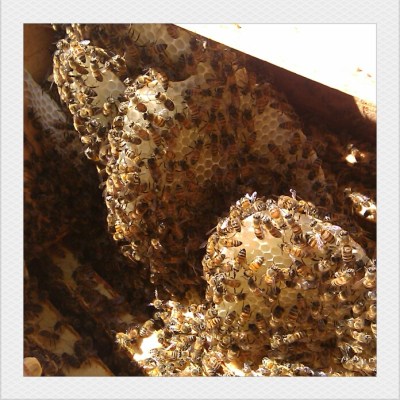
It should be noted that gold has long been a color of “the hive” in Mad Men. A color of productivity and being “on board” for the greater good; working as one for the vision. (Ted often wears gold.) While Peggy wore a literal image last week (her black, gold, and white honeycomb patterned dress), last night Don wore a black, white and gold striped tie while telling her she will make the presentation. He was willing to be on board, for the greater purpose, for once. Not for the company, but for Peggy. It’s as self-effacing an act as we have ever seen from Don.
So, though Matthew Weiner has said, “Mad Men is about the women,” and so often that is true, this season it was really equally about the men, being pushed to change, if they could manage it. Ginsberg could not, he’s locked in time, and it’s to be seen whether Ted can. Men this season were wrestling to figure out what the equivalent of their own moon landing would be, personally.
There is nothing, nothing on Mad Men I love more than seeing Roger work — really work. Roger still has fight in him. It highlights how lazy and indulgent he is that it takes so little for him to effect so much, for so many. Often, he can’t be bothered to stir; Roger is the king of phoning it in. In the finale Roger was no doubt further motivated by Bert’s passing. By age, he is likely to die next, and that heart attack still haunts him, hence this season’s Peter Pan-esque attempts at living and often grotesque and immature antics.
Jim Cutler’s future is very clear, but it’s a future that he’s almost 15 years too early in imagining. His instincts are spot on, though myopic. Cutler needs Don the most, professionally, but he can’t see it. He can’t yet fathom the limits of computers and data or the long term problem of unwavering hive mentality.
Bert’s passing was sad, and symbolic. From his dislike of Dawn being stationed at reception this season to the hypocrisy that arises from that (based on his love and adoration for all things Asian {but not the people?} as well as his undying love for Ida Blankenship) to the glimpses of him we get at home with his housekeeper, in full uniform who almost feels a bit like his “mammy,” Bert was out of time, a man that picked and chose his prejudices as they suited him. But he was also a great example of a character as a human being: fundamentally flawed and still with qualities that make him lovable and respectable. And isn’t that what family is? Robert Morse’s end scene was lovely. While I didn’t felt I needed the whole thing as a viewer, I did like the baton he was passing to Don, who knows he personally isn’t a spring chicken any longer, and like Bert, is watching proteges just hit their stride. Bert is as close to a father as Dick or Don will ever have.
Pete is a survivor. His tenacity alone is part young Roger Sterling, part Duck Phillips. He’s in it for life, and he does truly love it. Once he lives out his Don Draper fantasy as much as he can with his next-generation Betty Hofstadt, Bonnie Whiteside, his personal life will continue to be chaos, but what anchors him, much like Duck and Roger, will be advertising; it’s his North Star. So the question for all of them is voiced by a pipsqueak young Neil, the boy that exists inside each of them: now what?

This is the one occupying me, kicking my innards, turning, exploring.
I caught sight of myself in a window walking on the street today and had a split second of not recognizing myself, at all. I thought I was looking at a stranger until my brain pieced it. It’s like I’m wearing an odd costume.
 1481hyperion