new black moon

dt8788


A dear friend told me recently that when she heard Carolyn Forché speak, Carolyn said to ’empty the hands’ every day. Meaning, get thoughts out and words down so that the work that needs to come through has space to do so. This is just an emptying the hands post.


CW: discussion of alcohol and drinking and not drinking

Read More »


I wrote this a week ago and should have pitched it somewhere, but the news cycle has moved (not unlike the eye of Sauron?), so no one is talking PokemonGO.
______________________


The International Dota2 is on. Almost no one I know in my daily life has any idea what that is, but about 60 million people worldwide are watching along with me. 
 
Egames and esports are huge, larger than most people in our country over age 30 can fathom. The prize pool for The International this year is currently at $19,731,737, with the first place team (of 5 men) taking almost $9 million. These are young men, many still in their teens.* The whole thing is mind-boggling for people who have had no idea esports were even a thing that’s been going on for years now.
IMG_20140721_112607684_HDR
 
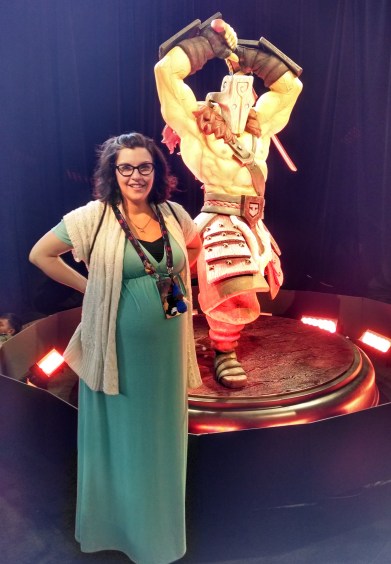
Here I am two years ago, swollen with child, at The International in 2014 in Seattle. Being a severely pregnant woman a few months from 40 at The International was sort of amazing. Some women there were in cosplay, as heroes from the game–Windrunner, Luna, Templar Assassin and the like. And there were also some hardcore women gamers, and then me: A fan, a would be player, and above all a student of games and gaming since early childhood. 
 
If you want to feel invisible, REALLY invisible, go to an esports tournament really pregnant. It was fascinating. I guess the range created by full-out young cosplay women and then me, on the entire other end of the spectrum–nearly middle-aged and pregnant, waddling about, was too much to compute… a fly in the ointment.
 
For me, gaming started so young. Some earliest memories are of being on a family member’s lap during penny Poker, Pinochle, and Euchre. I’d toss in the ante or throw out a bower. One of the things I understand best is the language of the game table–trash talk, shooting the shit, or slowly progressing conversations about important topics, frequently paused by the play of the hand, a mild expletive, the shuffle or the cut. I understand these cycles primarily, and the language and the pace. It’s a natural way to think and spend time and to be with family. 
 
It’s no surprise then that as kids my siblings and I were pretty taken with most games, outdoor and indoor. From TV Tag to Freeze Tag to Red Light / Green Light and Rotten Eggs, and the highlight of every single Summer night, Ghost in the Graveyard. If it was called a game, we three would play it. We had a 6ft. Christmas tree box packed full with board games. On more than one occasion we tried to play every game in a single sitting. I don’t think we ever accomplished it. And now when we are all together, a generous portion of our time is spent at a table, music going, playing cards or games, ideally all in pajamas, and having appropriate snacks and drinks. 
 
And it’s no surprise that at the age of 8, I started falling in with my older brother’s Dungeons and Dragons games with his friends. The alternative was hanging out with our older sister and her friends, talking about boys and social life; supremely dull to me. I was far more interested in virtual adventuring, slaying creatures, casting spells and finding loot. So when we got an Atari around the same time, we were three very happy kids. I have supremely fond memories of weekend nights spent playing Atari with my siblings, feeling safe and in fantastic worlds for what had to have been many hours.

As I grew up, Atari turned into Nintendo turned into computers and Xbox and tabletop gaming remained. There are video game worlds and series that are very special to me; I should always have a t-shirt on that says: “I’d rather be in Tamriel,” because it’s always, always true. Though I no longer have the time to keep up with any video games as a player, I’m always paying attention to what is happening because so much vital social critique and mirroring, as well as progressive art, is happening in gaming. All the hub bub about Grand Theft Auto? Those games are pretty brilliant satirical send ups of our culture–a harsh but true mirror by masterful game developers that outrage people who never play or understand them, which is great marketing.

So when I hear and see people, mostly much younger than me, disparaging Pokémon GO and its players, I always go to bat. It’s a conversation I will gladly have. It’s important to note that these people always seem to be white and privileged–the class I belong to, and the class that by default thinks that everything should be for them, and that their opinion about a subject should always *matter* and be welcomed. 
 
The conversation usually starts with someone listing negative news items about the game–peak fear headlines crafted to foster a shocked, frothing readership. Perhaps it’s because I write as well as game that I forget most people still don’t think of “journalism” and “industry” in the same breath. It’s not that good news doesn’t sell, although it doesn’t, it’s about magnifying narratives that do sell. Simply, writers are often paid to concentrate of the negative slants of any story. It creates audience and drives up advertiser revenues. Isolated, negative incidents magnified by writers who get paid by the word (read: create more news to make more money and try to make a living) for news that’s sure to go viral–requiring more follow-up stories–is how a lot of people pay their bills, including many of my friends. The negative stories resonate with people who don’t game., don’t get it, and have no context or knowledge about the topic. They are walking in on the middle of a conversation and sharing opinions they have been prompted to have by a news outlet trying to generate audience.
 
The average age of the Pokémon GO player base is mid to late 20s, with 40% of players being over 30. So while news stories about pedophiles or muggers targeting Pokestops are troubling, they are extremely rare. There are 9.5 million active daily players; that many people doing *anything* is going to result in issues. What is conveniently ignored are the wider trends–people with anxiety or depression getting out of the house, walking, discovering local areas, meeting people, enjoying fresh air, comparing Pokédex. It’s like a giant scavenger hunt and everyone is welcome. 
 

As an introvert and person with severe social anxiety, I can attest that Pokémon GO is a pretty warming experience. Though I’ve uninstalled the game, I played long enough to understand it and have the game play experience and be informed. Indeed, there are far more stories about people with ASD or mental illness interacting in ways that they have not been able to for sometimes years, than there are about pedophiles and muggings. Last week when I was feeling ‘meh’ and stressed, I found myself with 30 minutes to kill and parked and walked a few miles around a heavily Pokestop-populated downtown area, where I saw a lot of people seemingly like me who enjoy being among people for a spell, but not necessarily interacting, having a sense of community and happy, shared experience. I saw a 65-year-old woman comparing Pokédex with a 20-year-old man, and an older man in a wheelchair being pushed by a young woman–he was navigating, telling her where they needed to go next.

In just two weeks of playing, I had a number of similar experiences and saw many people having them as well. To decry something that isn’t for you, that you don’t do, isn’t your community, and a medium one has no knowledge of or conext for beside a few headlines crafted to cause pearl-clutching, is awfully naive. Perhaps groups of people gathered in one place staring at their phones trying to catch a creature are having exactly the right experience for them… one that suits them, allows them to be themselves and function in the way that gives them a feeling of belonging. If Pokémon GO is the end of our society as we know it, as many want to believe, then our end times look awfully fun. 
 
* Obviously The International and DOTA2 are playing a myopic short game, unwilling to look a few years into the future and the full dismantling of the concept of gender binary which is steadily, thankfully falling apart. Their leagues separated by birth-assigned gender are already antiquated as well as overtly prejudiced and sexist. There is seemingly no explanation as to why Valve believes women are less neurologically capable than men, and no logical plan to integrate trans and gender queer players into leagues. And no explanation why, despite having playable male and female heroes, teams would not be integrated.

notes

notes for a poem, and all the feathers i’ve found at my feet within the last month.

____________________________

temple

a clutch of thick / lilac at the entrance, woven / silver bowl, stone / fruits. water poured runs / it through. two / webbed coals glow. / from them: sturdy white / hyacinths. a breath in; / call back your own iron / fillings. an exhale mutates / them: gems drop piling. / ribbons wind back the spine’s / spool. all walls anointed hyssop, myrrh.


20160730_105857

Heralds, augurs

For four years, I receive dead birds. At my door, at my feet, in my exact path. I have no cats. There are no cats around. Cats are not bringing me the birds. The birds exhibit. Show me they’ve perished, roll forth a narrative in last action and symbol.

CW: Images- dead birds Read More »

How something can be that’s not yet

Wait each new moon,

make burn lists. Bury after

light; barefoot push the shovel.


Pull earth up, skies down in self

and recall — make minerals of you;

an iron in clouds yields the site.

______________


^  A trifle for the new moon & crooked-mouthed realizing it’s no-joke-too-late for a convent.

Jacaszek playing, and Richter’s Iconography; the latter always the black drive to high desert in snow storm; the only car on the pass and sensation of leaving the Earth.


Solstice & Strawberry Moon

During pregnancy, some women told me that if I had an existing ability to strongly intuit or a tie to the divine, pregnancy and delivery could heighten those abilities. The women who say this do so quickly, with pulled lips and in the same tone that they mention mastitis, or the linea nigra… things that can happen, things you should be aware of.  It has been entirely true for me.


Today is the Full Moon in Sagittarius, and the Summer Solstice. This hasn’t happened quite like this since 1948 (a different version was in 1967, as cited in the link below).


These last months I’ve been clearly, constantly urged to shed that which is not mine but was given to me from inception forward. Profound grief, systems of cruelty, and the weight of so much emotional cargo not belonging to me. None of which is me. I feel a strong need to continue dismantling, and to continue to rid myself of that which isn’t mine. And, to somehow recall and manifest who I was before I got here. I’m at once completely vulnerable, and not at all.


I see you, sweet readers. I see those of you who came over from the old blog, quietly emailing me your thoughts and warm, continuing conversation. And the readers who pop in to see if anything is new in my life (so much is new). Even if you don’t feel a tie to the earth or greater cycles and systems of creation, it’s a great time to set new intentions, work to leave behind what’s no longer serving you, and be willing to be wrong about who you are. Give up everything that was never yours to begin with and facet yourself in a truer form.


“It is a tender time.” More on this solstice / full moon by someone waaay more qualified at woo than myself:


20160605_084856

BT apiary garden. Protected spring-fed creek with Northern Red Legged frogs.

Gravidity

Image

This is the one occupying me, kicking my innards, turning, exploring.

I caught sight of myself in a window walking on the street today and had a split second of not recognizing myself, at all. I thought I was looking at a stranger until my brain pieced it. It’s like I’m wearing an odd costume.

The first three months were complete illness and misery. Thankfully the fabled second-trimester-golden-time has held true, and it has been a largely halcyon period of: generous spring weather, pervasive blossoms, petals raining to the ground, long walks on the nature trail, extreme busyness with bees (and all things swarms), and happy friends and events. I’m just now, at 5 months, starting to really slow. Getting up is a thing, bending over requires negotiation, and turning over in bed is a whole endeavor.

Still, I remain glad for the many things that are happening. I’m glad this child will have photos of me (while its in utero), giving well-attended poetry readings, having adventures, and doing a lot of beekeeping. I’m also glad the book I’m curating and editing will be released shortly after the birth. I will host and attend related events with said child in a sling, around my body, mewling as I give readings and introduce esteemed writers. I also feel driven to work on writing and submit my work for publication, though I’m poor at executing submissions (I make it harder than it need be). I can already feel the invisibility that comes, at least temporarily, with parenthood. With the exception of writers and some loved one, people don’t see me so much right now, they see a pregnant me; they see what is happening, actively. I also know that out of necessity, there will be long months after the birth when writing will likely be a wish.

It’s strange that something so primary (pregnancy and birth), can be so odd, but natural, at the same time. At once, I’m shocked to find myself host to someone else; occupied. Two at once. And then when I feel the kicks and hiccups inside, it feels entirely logical that the child should be living its life inside of me. It makes me think about being ‘alien.’ Not in the Ripley-Ridley-Giger-Sci-fi way, but kind of too. It also makes me think about what it is to be female, to take in and be occupied by. What it is to be beings that can hold.

For someone that experiences the world almost entirely via sublimity / perception / analysis, being this physical, on this level, for this long, has been at times disturbing, and wholly curious. Since this pregnancy, it’s like I have been cut off from those tools of sensing; exiled somehow. I feel like an appendage is gone. All I can do now is to be utterly in my body and entirely present, which for me is extremely difficult for an extended period, and can often feel threatening. That said, for as unnerving as I find it, I know it is challenging and healthy for me to be encountering, and having to cope with being physical and human. It’s a complete act of faith. And there is a large part of me, the part that is fulfilled by pain which results in revolution and transcendence, that is looking forward to labor.

The most surprising but not unexpected oddity that pregnancy has ignited for me, is the similarity between abuse and pregnancy. In many ways they are identical, though through this experience of pregnancy I have the benefit of: 1) Being a mature adult making decisions for my body on my own behalf, 2) Decades of hard work and understanding regarding myself, my body and memory, and my perpetrators, and 3) Coping mechanisms and a support system. The similarities are easy to perceive and understand in that: something is happening to my body without my permission. Just when I get used to what a new week brings, be it round ligament pains, fainting, joints loosening, muscles not cooperating, it all changes again and my body begins displaying new, unknown behaviors and pains. And all of these ongoing pains and changes are happening at the site of original trauma and mimicking effects of original injuries.

Indeed at times now, when I am not vigilant, when I’m depleted or feeling remote, an old, old sensation of terror, falling, panic, and entire doom cascades through me. For this reason, I know that labor will be quite interesting. The difference is though, that this is all my choice, and entirely on my terms. I want this result. I want my body to be in service to this. And as such, I want to feel every sensation of labor – every wave of pain and my body holding and then giving. The reason being: I suspect labor will be (for me) the other side of the coin from abuse; a true healing after trauma and the years and years of repeatedly defusing it, via transformation. Were I younger, were I less mature, knowledgeable, and with less command over managing PTSD and disruptive memories, this would not be the raw, impressive experience it is.

I know these considerations I’ve recorded here are not particularly remarkable and are still roughly hewn. A fellow writer friend’s child is a year old and she still hasn’t written about the child or the experience. I can see why: it’s so much to digest and gain perspective on enough to have anything worthwhile to say. Still, I feel a need to turn it over, look at the facets, and try to understand. Especially as my body — which I have spent so much of my life being at battle with on so many levels, functions in these singular ways; naturally, and in spite of me. It spreads, swells, splays, readies itself. I waddle around in this hot weather. I wince at the thought of the coming hot months. I shed every layer I can. I eat as my body demands and rest before it fails. I sleep and sleep and sleep. And my dreams are astounding films that stagger me when I awake to rise.

In other news, I’m really taken with the photographic records of microscopic tears recently done by Rose-Lynn Fisher. They are sort of like Masaru Emoto’s work without the controversy or room for debate – just pictures of what she saw.


A Lament and Foreshadow

I want to write about what it has been like to rehab these two little creatures, these dogs, terribly treated prior to our home, and the work to bring them to flourish. Or mostly flourish. As The National sang: Once ruined, baby you stay ruined. While they now thrive, especially Polly, deep parts in both dogs remain vigilant for what their cells remember – muscle memory, conditioned response, PTSD.

These have been the tools used (applicable in most relationships): calm, consistency, patience, schedule, compassion. Some of these might read as synonyms, but are not when employed as verbs.

We are not a yelling people in our house. At worst, we bicker. And we hold no grudges, pull away, ignore. No one goes silent as an attempt to punish or test. It took the dogs very long to realize that no explosive reactions would happen. If a door slams, it is an accident.

If a book slipped or cup broke after she first arrived, Polly would cower in a corner, looking up, bloomed eyes from over a lowered nose, tail tucked and ears slick against her head. She has not done that for years. She would shake and cower if we moved too quickly or, if our voices raised at the TV for sports, she would dash from the room.

Image

Fred is smaller, and came to us far more traumatized than Polly had been. He has seizures, possibly brought about from head trauma, still dislikes his head being touched, and has poor vision. After he eats, he sits and cries. We don’t know why and never will and no amount of consoling him has helped, though the crying no longer lasts for much length of time. He still sometimes rushes away if we move too quickly near him, but not always. More often now, he sits and stares up at us, uncertain at worst. And, observing his worry, we scoop him up in a firm, secure hug.

I know that had we (as stewards of him) been different, more erratic, less patient, we would have driven him over the emotional edge he was occupying when we found him, and he would be a neurotic, chaotic dog in constant misery.

His fright has lessened considerably; he knows we won’t hurt him physically or psychologically. His mistrust of women, and strangers, is extremely lessened. He even becomes curious now and seeks us out, and that is something that levels me to see. While he starts off the night sleeping in a crate, at some point he joins us on the bed, and we often wake up with his head between ours.

Image

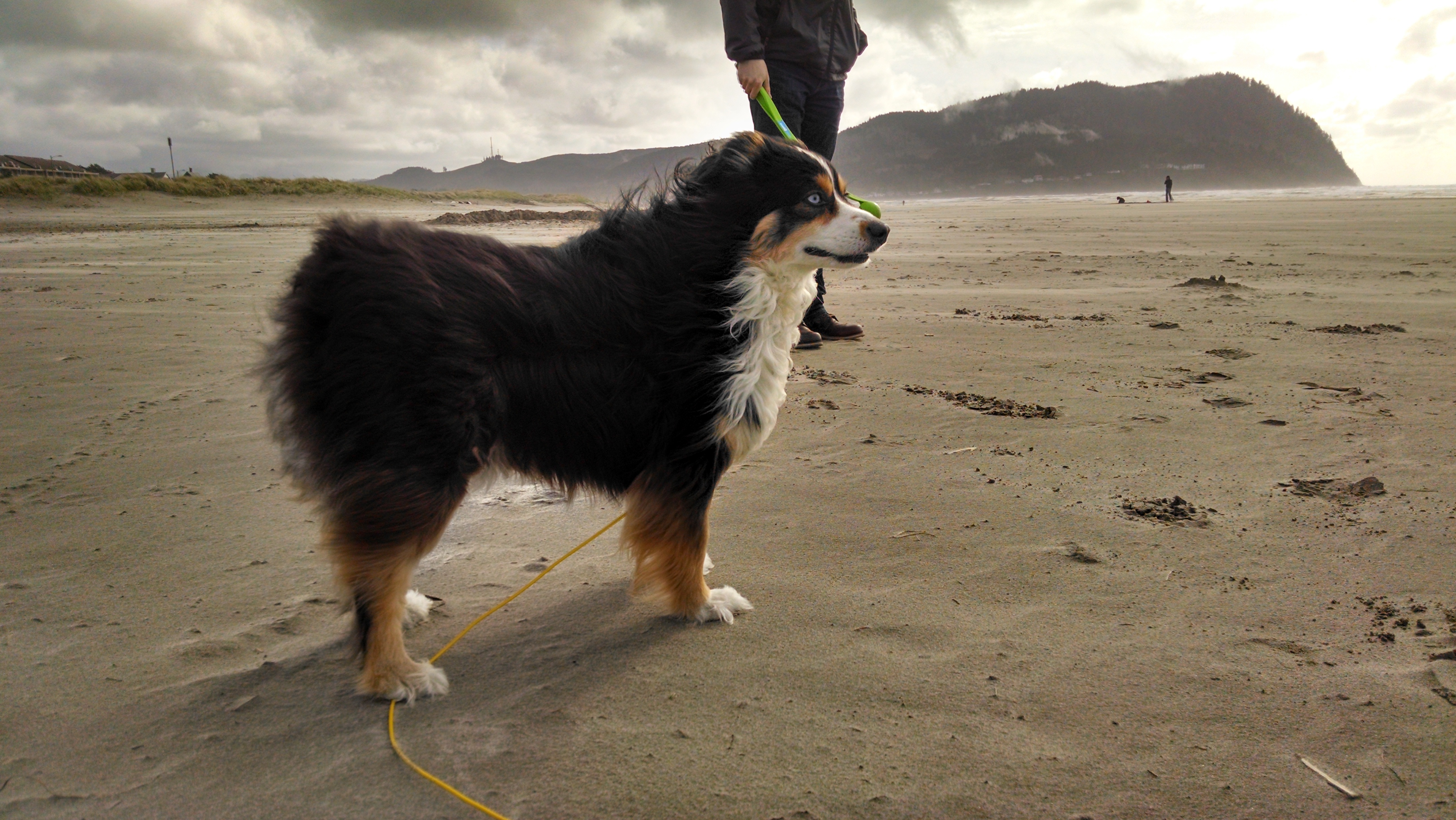
Last week we stayed at the Oregon coast. The Oregon coast is never warm, not truly. It is windy and fairly wild, and often rather stunning. In colder months it is sparsely populated. We took the dogs with, playing each day on the beach. No fences, just expanse, and a ball to chase. They were delighted, and we are delighted to witness their happiness, their trust and thriving. It humbles and levels me to watch.

If this all reads like a lament, in part it is. And I knew it even while we were at the beach. In 5.5 months our first child will arrive. I know from both simple logic and the reminding of others, that soon our dogs will be largely ignored out of necessity and for quite some time. At the beach, I needed to see how happy they can be, their capacity for it, how much they have changed.

I know that what I see in them, the remains of the trauma, is much about me and my own. It’s sort of Lacanian – needing to find a sense of mastery over something I had no ability  to control or effect. The home I needed to actualize for them is the home I have also needed to live in, with patience, calm, certainty, and terminal compassion. For a great portion of my life, I was not so different from these dogs and the state they arrived in, the results of their experience. There is no mystery in that.

Both dogs are alert to change. In the first trimester (of this pregnancy), the dogs took turns resting on my torso (in between my bouts of illness), just protecting me. And, whipping their heads about to watch what was in the air around me – perhaps the mutation of physical and spiritual states, or visitations. They sniff me curiously, lay immediately at my feet, bark at anything they suspect might be nearing our house, be it  leaf or wind or human. Soon they will be weary with me, late at night with a new mewling, wondering why we are up, why the new one is crying, when it will stop. They won’t understand why I don’t have the time for them I used to. But I know they are both healed enough to love the new little one from a place of assurance, and that despite changes, they remain loved, important, and wholly significant.

Image


Weather Report

In a subtle climate, one becomes quick to notice smallest changes; everything we are is about the growing season and how much snow is on the mountain, how high or low the rivers are. Winter has been a worry, on the heels of an odd autumn. Autumn was a prolonged dry spell, with an uncharacteristic metallic sun hanging, and no rain to put the season to bed. The bees were tested with no food left to collect and no signal to huddle inside and wait it all out.

Winter has been sinister-dry with the same sun but a brass color with cheap gold overlay. Except the rain has finally come, not in usual constant drizzle, but in sporadic, protracted, great torrents. Enough to startle us from sleep to check the basement, foundation, outside areas. Today I picked up tree parts in our yard, deposited by trees we don’t even have.

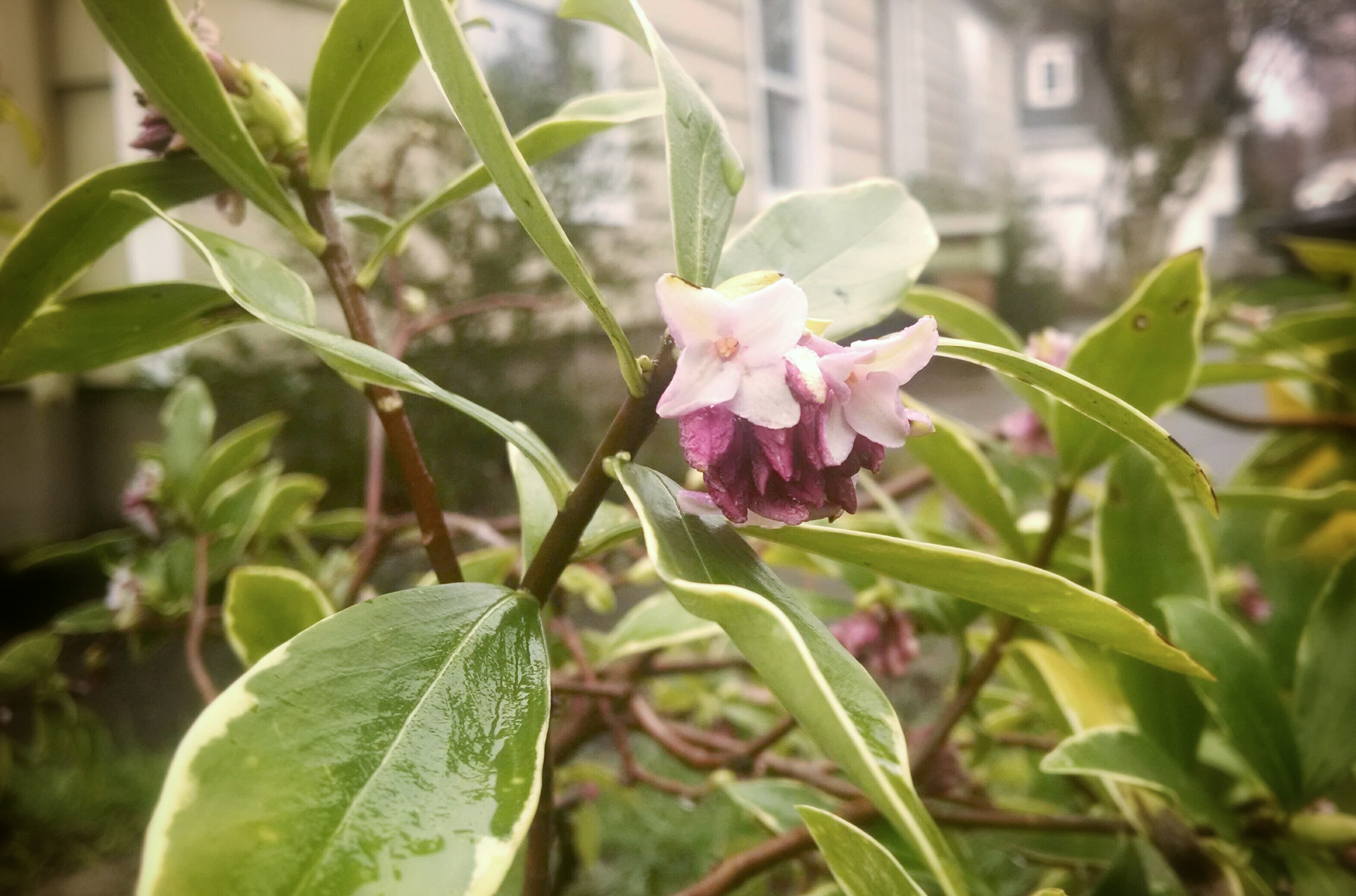
The Daphne is a month late. And now that it has bloomed, those blooms bear brown spots as if it is ready to quit. The usual scent of ambrosia has a sour note like glue; like on its last legs. The ground is past soaked sponges, gone to deep mud for slipping — everywhere is footprints filling in behind.

During a national conference of permaculturists 4 years ago, one told me: Yeah, this will be a rain forest in 50 years. I can see it, and I think about it a lot. Our voices, music, TV have to be turned up over downpours. It’s loud. It sounds like we are living in a washing machine.

I always speak of moving, but where is there to go?

daphne
Some of the more hopeful Daphne.

Holiday, Chicago, exile

There is an image floating around social networks proclaiming: “Only 10 Saturdays until Christmas!”. It seems odd, and pressing.

Today a friend from back home arrives to stay with us. I realized that he is an old friend, despite having met him when I was 27… I’m old enough to have friends that I met in my late 20s, and have known for a decade.

He and I were roommates in the last apartment that I lived in in Chicago, before I left. That leaving was such a shocking, but natural fissure in my life. As I get older the things that sit on my personal time line, like mines having gone off, retain their potency, but patina in such strange, mutable ways.

When I think of leaving Chicago, I think of breathing after so many years of having prevented any breath. I think of an animal shaking off trauma, just before it darts for the forest line and is gone.

I love Chicago, I miss Chicago, I doubt I will live there again.
In retrospect, and in my writing, what the city is and was for me was an unhealthy relationship of supreme, terminal love — on a cellular level. A meshing and fusion that can’t be undone. A permanent imprinting. And habitual mistreatment. But I think that’s what Chicago is; it’s how it treats its citizens… a punch to the sternum, then it goes in for the cuddle. I was always asking that city for things it wasn’t capable of giving, and it always wanted me to be different than I was.

This was supposed to be a post about time. Maybe it is. Every year, multiple times, I try to figure out how I got here. And how I am still here. Portland is not my place, but Portland wants me. Portland welcomingly spreads out, and gives and gives. But Portland can’t tattoo itself on my vein ways. It’s not my familiar. I’m always a refugee here, or in exile. Equal parts both.

The old friend that is coming to visit understands all of this. We have had long conversations, with Bourbon, about how difficult and compelling Chicago is. He escaped to the west coast not long after I left home, but work took him back after just a few years. Now he is befuddled, asking the same questions that I do: “How did I get here?” and “How am I still here?”

Only 10 Saturdays until Christmas. So, only 9 Saturdays plus a few days until my birthday. Back home, I would often gather some friends and family and head to the Walnut Room for birthday lunch and then The Art Institute after. My family had done that a few times when I was very small. An early memory is of a piece of Buche de Noel set before me in that room, next to the huge Christmas tree. As an adult, it was equally delightful to eat there, surrounded by dressed-up elderly patrons, and moms with kids. There is something strangely nourishing about the loneliness of being next to that huge tree, the ceremony of the season, and the terminal isolation that the city and its architecture provides that I always long for. But then, I was growing so tired of being lonely amongst so much that I loved, living in it, but not being able to get what I needed.
Macys-on-State-Great-Tree
photo: Walnut Room. concieregpreferred.com

It’s come Autumn and Winter that I miss home the most. I love layers and layers of woolens. I  love snow. I love being slapped in the face with cold when the door opens, and the room sighing its warmth back when the door closes. I miss sitting by the lake in Evanston, alone, when the sun is fading white gold and brass colored. I miss my old roommate. I miss the Music Box and the old Fine Arts theater. I miss trains.

But the best Christmas I’ve ever had was two years ago. Having a lot of German blood, from my Mom’s side, while growing up our family opened gifts and did the primary celebrating on Christmas Eve. This puzzles my husband, whose adoptive family is terminally English.

Two years ago I gave up trying to make Christmas Eve *magical.* It’s just the two of us anyway, and the dogs. And Matt barely eats so even if I go all-out on a meal, it’s is pretty lost on him. That year we opened gifts early, had Old Fashioneds per his family’s tradition, and went out to eat at an Indian restaurant. The city was dead but string lights pressed against windows towards quiet, grey streets. We walked around and saw only a few others — people with nowhere to go or avoiding where they were supposed to be going; a few tourists. We walked past windows where people sat at meals chuckling and drinking. I remember how quiet it was, how empty outside on the street.

After dinner we went to a movie in a theater with only a few other hardened holiday soldiers in the seats aside from us. And then we walked to church for midnight service. It was an extremely simple holiday. In retrospect, I think what is most indelible is that by breaking tradition it was acknowledging (personally, internally), that the holiday had become about me waiting for someone(s) that wasn’t/weren’t coming. And who those people are, and what they were to me, or what they could have been, or could be to me.

I remember shockingly early memories of from this life. It has always startled people how early my memory can track back, which later became surprising because of the sheer years in the middle that my brain has wiped out. One very early memory is when a terrible thing happened, and due to it I was in a liminal state, not in this world and not in the other. While in that place, suddenly my Grandfather, who had passed the year before I was born, was standing on my left holding my hand. We were on a cold, dark street at night, under a street lamp glowing cold white light. We were dressed for the chill and looking up at a large white house. Inside, my family was gathered around big table, eating a large meal. Some of them I recognized and some of them I just knew were family. I looked up at my Grandfather and asked him if I could stay with him. He frowned and said no.

I mention this because last week I was driving home at night and puzzling over intimate worries: all of the miscarriages this year, another year without children, losing each of those. The loss of Matt’s dad. Complicated relationships. People I miss. How depleted we are. Raw. And I was panicking about writing and fears of dying without having published or written what I want to. I pulled in the driveway and got out of the car, walking over to the quiet, cold street to get the mail. I was directly under the newly installed street lamp, flipping through envelopes and instantly heard, from a place deeply-seated in me, a male voice say: It’s all going to work out. Just like that.

Here is the point where I would usually take strings from each theme of this piece, relate them in a subtly sentimental way and tie them up to end on a tidy, but potent note, but I’m really disinterested in tidiness. I’m really disinterested in zing-y endings. Interestingly, for someone that spins their brain and mentally chews it into a sad wad of pulp daily, I didn’t think anything immediately after that moment happened, I just stood under the street lamp, looked back at our house, and a split moment of peace and faith that it was true: It’s all going to work out. Of course, that moment passed and I started wondering exactly what that applied to, but try as I might to parse it, I know the statement applies to everything. Knowing that, deeply, on a daily basis is the difficulty. Especially when what I want, what I need, and what I end up with are such different things.

(It should be noted that I I have pneumonia. Again. This is at least my 12th bout of pneumonia in my life. I rank them, from least scary to, ‘holy-wow, I can’t believe I am still alive.’ This one is high up there and is probably partly the cause of homesickness, wandering thought, and fretting about having faith. Pneumonia is an amazing illness. It sits you back, down, hard into yourself, like you are piloting your body from a tiny, tiny room. And everything feels a hundred times more potent than it normally does, yet strangely removed.

Last night I watched the film “Insect Woman,” by Shôhei Imamura, 1963. It was amazing.)