Cross-town

I’m cleaning out drafts, and this has been sitting for a couple of years. I scroll past it, but I’m not sure why. I think that I dislike talking about Chicago for a pile of reasons. Chicago is directly on my Pluto line, which fits because I had several severe, near-death experiences there and decades of trauma. But mostly, now it is truly somebody else’s life. It’s so far from me and who I am, it feels more like speaking about a character I studied. It’s something I lived through and something I survived. It’s a city full of traps, ghosts, and bruises.

________

I met an older woman from Chicago. It doesn’t happen that often out here. I don’t know how it quite came up. She was talking about her struggles to see all Cubs games via Roku, so I knew our soft rift was coming—a forked divergence. I didn’t break it to her right away. It’s a specific dialect in split hairs based on the prejudices and proclivities of symbolic geography. 

She went into her history, of her Grandfather at WGN in the 30’s, Bozo, her Dad’s work with the McCaskeys, where she was on September 11. It’s a thing. She wanted what I have too, but mine’s just meager: the registrar at the Art Institute in the 20’s, being a sommelier at Jordan’s starred, fine dining space, some service staff at the Armour mansion, and 86ing a drunk, young Pritzker on Michigan Avenue.

I don’t share much. My people just survived. Some with airs and aspirations, a fading knowledge of old world stability, some without any at all except hunger and harm.

I got in mild trouble for 86ing that Pritzker, from the kind, but inauthentic boss who asked me out so gently and respectfully once and even though he was handsome, tall, and perceptive, I could tell he spent time binge drinking to try and ignore those deeper parts of him, and betraying his authenticity to fit in with groups that I doubt he actually wanted to fit in with. He surely sat in the bleachers at Cubs games with college friends who made women feel unsafe, his pressed khakis and button-ups to mask whatever he was really feeling inside. 

I didn’t want to be somebody’s way they figured themselves out. I was already too far working on the inside and dissecting my wounds for wisdom to spend time helping someone skirt around theirs. I was already the sharp knives version of me, all starving and edges to parse through what had happened with maximum perseveration and zero safe connection to my body. A smear of ether, defense, and sparks everywhere I went to make some sense of it. All reactivity and survival.

That was the same place the other manager cornered me in the back of the house, asking me why I wouldn’t go out with him while getting closer and closer until I couldn’t move except to shove past his arm hard with my left hip. I told that other nice, tall manager, who actually got it, and it never happened again. 

It was a funny place, in the heart of Gold Coast, where all sorts of notables would stay when they flew in for their appearances and talks. Lots of politicians and newscasters, and niche celebs. Beautiful high-end sex workers and jazz musicians between sets at nearby hotel lounges.

In that same place, the third manager (who was depressed, but real) and I talked about music, and he loaned me his Silver Mt Zion albums. He asked me out, too, but my policy was always the same – I don’t date people I work with, so that was that. And anyway, I was already getting ready to be done with being sad. It’s telling how many were drawn to me when I was all wounds, and the frenzy of alchemical and visceral work to fix them, the place where pain is distilled into the fuel for transformation.

There was a server named Christian who had eyes that showed he was pieces inside from having been raised in a cult that wasn’t kind to children. He spoke about it freely, and there was a peace I had when working with him because we could feel the reality of the other. He was at an age where he was processing—far enough away from the events, but not so far that he had found a way to live with it yet. By saying it, he was hearing his story hit air, and making sense of it based on reactions from others. I don’t know if he knew it, but we were all protective of him.

And I worked with a middle-aged man, a functioning drug user who managed his use well and always called me ‘fine-ass’ plus my first name, with a smile, which from him wasn’t gross but hilarious and somehow managed to be a genuine compliment. And his cousin, who was so nice, but managed his drug use far less well, so we all helped him out to make it through each night smoothly. The first one taught me that you can say anything you want as long as you smile while you’re saying it. 

That’s where I was working when the WTC was bombed. I had to go to work that day before planes were grounded because nobody could fly out, and the tall manager thought it would be busy. I went into the city, the only vehicle on Lake Shore going in, while every car was streaming out. That day, Stan Lee was dining because his flight was canceled, and one of the servers was thrilled, but it was hard to be excited because the news was of things actively collapsing. A server named Julia was in the bathroom, throwing up, waiting to hear from her family. Later when she moved away, I moved into her Pilsen apartment.

Once, when I was buying wine for another restaurant, I left for lunch and went to The Drake to meet my other manager, a man who looked like a comic book hero and used to be a pro volleyball player. We were buying wine at auction for the high-end MJ restaurant. MJ drinks extremely good left-bank Bordeaux. In those days, the manager drove out to MJ’s house to drop off cases of Bordeaux from the 60s, and in 90-degree weather, he’d be drinking glasses of 1st growths while he hit golf balls out on his driveway.

Once I hit his shoulder with a Billecart-Salmon Rosé cork, and he was really nice about it. Once, I accidentally poisoned his lawyer with shellfish during an anxiety attack. I was always starving then.

That day at the auction we sampled bottles from the 30s and 40s and then I ran back and delivered salads dotted with dates and cornbread croutons, rolled up some silverware in napkins, and walked out into the night for the long, unsafe walk up the beach past small parties and up-to-no-goods and solos contemplating things, to the maddening concrete apartment where there was nowhere to go but on to the page. 

In the conversation with the older lady, we get to the part where she’s asking where my people are from. It’s hard to explain quickly. I say my dad’s family is from the South Side, which isn’t true, but it’s a shorthand for Irish that she’ll understand, and easier than explaining the North Side Irish, and Dean O’Banion, and then the family’s eventual settling in the suburbs. It’s enough to differentiate us. It’s enough to let her know: Catholic and White Sox. And then I add: My Mom was born on the North Side and then grew up in Wheaton. That’s enough for her to know: Protestant, and to them, sports don’t matter much. Not in the same way.

The White Sox predictably shift her. But I judge her for the same thing she judges me. I don’t tell her I lived right by Wrigley for a while, and what a damn mess, and the menace those fans are. Most of those game attendees are drunk tourists and frat boys in bad sandals with toenail fungus and no shirts, puking and pissing on the streets all around the park. Not there for the baseball, but for publicly drinking around their glaring insecurities. 

Everybody is a Cubs fan; it’s work to be a Sox fan, which feels way more Chicago. Way more along the lines of: the Lager Beer Riot, Pullman Strike, and Haymarket Affair. You have to want it, and you have to be willing to pay for it. Way less: Out for a beer with a pack of blatantly undiagnosed menaces. But ultimately, what does it matter? It’s just a coded language waving in the air.

All of this is packed into a conversation I have in my head around her because there’s no way to make the discussion real, past geographic, verbal, symbolic stenotype. I could say: My grandma worked at the Maurice Lenell factory making Pinwheels and Jelly Stars. Her kitchen smelled like stale bread and cigarettes. All of my Great Aunts had dark shag basements with wood bars and pool tables, Catholic whiskey, and custom clay ashtrays made to fit their palms. In their living rooms, Wedgewood bric-a-brac. On Easter, orchids for the girls and mothers.

My mom’s dad was a printer making ads from lithography stones and retreating to the garage due to so much leftover shell shock and a wicked, undiagnosed wife behaving wickedly inside. His way to still love her was to let her be harmful. I come from many men who were dead cowards in relationships, afraid of their own emotional shadows. I come from women who had to be the men because of that. 

My grandfather hid and made stools, turned beautiful pedestals, and made a bird’s-eye maple dresser. He used melted toothbrush handles to make hinges, and airplane windows to make photo albums, all instead of rising in his life and self; a fear of discomfort, a fear of his own growth. Nearly everybody in that family was or is a frustrated maker and artist. Everybody was always hiding from whatever was harder to do—overdeveloped in one area, stunted and quaking in the other, and making those around them pay for it.

The older lady had a different experience from mine. She talks about spending time on their boat on the lake, their WGN box at Wrigley, and how she still gets a card from the McCaskeys at Christmas. I’m sure she never fainted in a cold drop outside the Music Box from a movie that made repressed and surfacing memories flood back into her body, and her first memories are not of sitting on laps of varying safety watching people play penny Pinochle in smoky kitchens well past bedtime, or cracking out the fine china and silver only twice a year dressed in velvet for an uncomfortable, ceremonial holiday skirting around brutal truths and watching permitted, simmering abuses unfold.

I don’t think she’s conscious of it all as we converse. She hasn’t had to be. She has never found herself at a random gala a friend had an extra ticket to, and then later changing her clothes under the clothes she was already wearing while on the El to go to her friend’s new band’s show with a midnight start at the filthy punk bar. She hasn’t lived high/low enough to know how to seamlessly be both, and when, and where.

retrospect/uncircumspect

I had this sitting in drafts for more than a year, from when I was mentally measuring how far I had to get from myself, from certain parts of myself, and how the parts of myself I moved into were about a different dialect of survival than I had previously known. I also had a risky curiosity about defamiliarizing the self, elected a brand of punishment for what I perceived as a failure, and a wonder about what remains of the self in elected abandonment and alienation.

______

The mutability I conduct necessitates an identified frame that provides a measure for how far I can recede or expand myself, otherwise, the expansion or contraction will simply continue to unspool. And even when it exceeds or shrinks, I was previously too often taken by the movement itself to stop or cease. The momentum became a curiosity, and the effect it had on others was a way to try and please, achieve, and stretch myself, but often meant self abandoning for the interest in witnessing another’s subsequent movement or action, or an outcome I was simply interested in seeing if I could create. A sort of energetic Stretch Armstrong for the sake of it. Again, a curiosity. And probably an excess of creativity.

And, being this mutable, this Sagittarian and Piscean, while the editions of myself that have unfolded over decades have differed somewhat, I know why ages 32-40 were such a stark shock to this life. Why I elected as much. And I knew even then, why I abandoned most of the core of me, occupying my own perimeter, filling in the radius, and abandoning the center aside from a thin, exposed shimmer of the soul; like a cat clinging to the walls of its own room. I know exactly why but it doesn’t make the image or experience any less of a shock to measure from this distance and time. Or, the toll upon my body any less extreme. You can abandon your body for your mind, or your mind for your body, but you will still be charged either way.

I’d occupy the center in potent, technicolor iterations for short times to find out if I was still there. I remember showing up for my dissertation in work coveralls and MAC Ruby Woo lips, pale as a candle and fine fissures throughout from the work. Leni asked me what it meant to write it and I answered incandescent, crying, but in an exhausted cry. Weak, thin tears that made no difference to the state I was in. Like waking up a moment from sleep during a recent grief and realizing you were crying in your dream anyway. But I left there and shut the door. Returned to my own perimeter, stepping over much of myself on the way. A way to live around the mess of wounded, abandoned, and writhing sentience and only access the creative force. Extract the marrow but ignore the meal, unable to occupy my own body in a way that could allow the pain to quarter for a moment.

Between the ages of (I argue) 37-50ish we undergo tremendous Plutonian destruction and then resurrection. Some will get through this period still needing to cling to the fabricated identity of themselves they had hewn in the Saturn return in the late 20s to early 30s. And while that’s the first blush of our adult selves, it isn’t made to carry us through a whole maturation. That’s where Pluto, Uranus, and Neptune go to work in the mid ages. We’re meant to mature by aligning back to our soul and this incarnation’s goals, and then making new choices from that point — in partnership, friendship, work, values, vision, and faith — that better fit our primary self that was born into this life, and that many of us had to fight to keep sight of.

If the mid-life transits (or, the mid-life crisis), which everybody must pass through and is arguably the hardest point of any life lived as long, is the appearance of urge for the unlived life, or, we are led to the door of our unlived life. We can watch as some surrender to it, some choose to fight it and fail, and some are cataclysm-ed and then transformed by it. It tries to reset us to where we’re supposed to be, a jolting realignment, breaking all the ways built on false soil, and where we had ‘notions’ about ourselves or moved too far from our truth.

When I was younger I sometimes took far greater risks than I could afford, and getting as away from my core self as I could was one such way. Generally it turned out fine, resulting in remarkable or rare experiences that made good stories, shaped me for the better, or became important self-secrets, but when it did not, it really did not. And it’s this mutability, coupled with the most sensitive of nervous systems, which should have been protected and sheltered at first by family, and then later by myself. But I didn’t come to that realization until a decade ago and then hurried to push everything away to methodically and deliberately titrate — in a way that’s inherent to me but was not previously allowed — what would be allowed to come in.

If we are individuals who didn’t have families that at least partly fostered and honored our individuality and singular needs and curiosities, we had to steal glimpses of ourselves in far smaller ways, lifting reflections from where we found ourselves most illuminated, even when it was only a spark, suspicion, or resonance.

There are mundane moments in life from when I was young that have stuck with me. Non-remarkable, quickly passing moments where I could feel my soul stretch and breathe before needing to take cover again. One was at a zoo field trip. It was a bright day and warm late spring weather and I had finished eating lunch on the grass outside. My friends had gone in to rejoin the group but we still had time. I realized that nobody who knew me was around. And my family had no idea where I was. And I felt elated to just be out in the world, unknown, and free and alone. It was a tremendous feeling of liberation. Of just being a living breathing thing in the world, energy connecting with other energy. I thought of leaving to experience more of that feeling but couldn’t figure out where I would go.

And another, ice skating on a frozen pond in the winter among tilting, dead, soft yellow prairie grass in winter. I was with my best friend and we were off the side of a pretty busy road. Her mom had just dropped us off and we trotted through the collapsing grasses to the pond and laced on our skates. Two young girls just skating on a frozen pond alone with no sound but some distant cars and wind and a time on a watch we should be ready to leave by.

I knew who I was in museums, in the city, in nature. I knew who I was alone, in rooms, with music, on the floor, at the movies, and especially on paper. But all of those moments were extremely fleeting, mocked, judged, or prevented. Life was in service to the fabricated identities and the terminal fragility and immature violences of others.

It’s impossible when living in a war zone of abuse to figure out who you are. Who you are will not get you fed or seen. Who you are must become a survivalist specializing in the ways that will hopefully generate the least pain on any given day.

When life opens up and becomes more or less your own, it takes years if not decades (and some are never able) to stop magnetizing the same landscape that was lived in. If you are a boxer, you find people to box and situations you have to fight. But if you want to love somebody, especially the self, you have to unlearn that fight. You have to know when you need or want the gloves, and when to keep your hands in ice. And if you are growing in that way, you will need the gloves very infrequently if at all.

I don’t know when I was farthest from myself and pressed into all of the strange secondary aspects of myself, living around my own light. I know I wore a lot of colors, I ate food. There was less blood, and blades. I oriented myself to an osprey nest. I befriended the snakes in my yard, I otherwise let almost my whole life out on contract to others. But I found this piece of writing and I think this was pretty close. By age 38 I knew I had gone too far past myself, and simultaneously, had collapsed in on myself. I knew I was the negative space of myself, hesitant pencil marks and clear surface making my shape. I knew by that age I was going to have to die or resurrect. Eventually, I’d do both, in both literal and spiritual ways.

“And it always felt like I have this unknown deal that’s hard for me to keep.” That’s it. Some part of me knew what I was doing, the cost, and that I was going to keep doing it a while more. It was a costly exile. And a permeating, shocking, fathomless, saturated birth and return after.

First Sting(s)

Following is a blog post I wrote for Winged’s blog.

The first time I got stung by a bee, I can’t be sure it was a bee. In retrospect it was likely a yellow jacket, but I can’t know. I remember it was a hot, mid-western summer day with insects screaming out their songs: “scKzzzzssT… scKzzzzzssT,” and I was small – probably 6 or so.

I was standing in our narrow garage which was opened to the driveway. Likely I was deciding which vehicle I was going to take out for a spin: the Big Wheel, the pickle car (don’t ask), or the Green Machine. I was not a bike rider. My siblings’ bikes were always too big for me and I was fearful of the heavy frames and the extreme distance to the ground once seated; I wanted to be able to bail out with a soft tumble if need be, not take the hard fall on the concrete, yielding stinging, scraped legs and arms.

Even at that raw age, friends and siblings had long warned me about the possibility of getting stung by a bee, so I wonder if I didn’t just want to get it over with. I had been promised by my friend across the street that the pain would be like death; that I would probably want to die. So that day when a bee flew in the garage and began inspecting me to see if I could possibly yield nectar or pollen, I panicked. I eschewed the instruction that had been drilled into me by my wise, experienced friends and siblings, being: Don’t move, and it will go away.

Naturally, I moved. A lot. In a remarkable, small-child’s dance motivated by fear of an unknown pain. And I began swatting, a lot. From what I can remember, the bee or wasp stung me on the right arm.

(Young me, dressed as something scary for Halloween.)

*

Growing up in suburban Chicagoland, there was almost no authentic relationship with nature; everything was abbreviated. The bug-spray truck drove down our street every summer night and we deeply inhaled that spray while trying to fall off to sleep. Our yard was chemically treated so no dandelions ever appeared. The corn fields at the mouth of our subdivision were sold and built up with houses before I was 10.

Despite that, some of my most vivid and important memories are of the verdurous nature that I could find. I was fascinated when we studied milkweed pods in the first grade – the way they broke and gave up white fuzz.  We had to wear rain boots that day which I didn’t have, so the teacher put garbage bags and rubber bands over my shoes and secured them up my legs.

My best friend had a Macintosh apple tree in her yard. I was charmed. That the tree could swell small green fruits into the ripe red ones I plucked off on warm days and immediately begin gobbling was thrilling. (The humble Macintosh remains one of my favorite snacking apples for this reason.)

The same friend once insisted I borrow her extra pair of ice skates so we could go skating on a pond near our houses. It was the first time I had ice skated and with the snow coming down, it remains a favorite memory. That solid pond, the snow, layers of clothes, no one else around, the gray sky and the pond wrung around with dry straw weeds and tall brown grasses frozen into place.

But by the time I was in highschool, nature had become a foreign locale. As it will, social life had long since taken over as wholly enthralling. At one point my group of friends got really into camping and going away for the weekend. On one trip to Devil’s Lake, everyone decided to go hiking which would involve some basic rock climbing. I eagerly set out with them. My friend Nick, looking down at my shoes, said, “…are you going to wear those?” I shrugged. I had no idea that black and white patent leather wingtips (with leather soles) might not be ideal hiking wear. I somehow managed to hike like a champ with those lovely dress shoes on.

 *

Before I moved to Portland, Oregon, in 2006 the three geographic choices that were before my boyfriend and I were: Portland, New York, and Philadelphia. I advocated for Portland, as I wanted to live somewhere exceptionally beautiful and I was tired of large-metropolitan city life. Chicago had wrung me out. I was depleted, afraid of how hardened I was becoming, and fearful that I couldn’t easily turn off my accent at will.

Upon arriving in Portland, the town was beautiful. I tried to be in love with it or at the very least, meld into it; its newness, fuzzy green firs towering, lush green expanses, welcoming, young population. The relationship I was in quickly fizzled. In one version of the story, the one my friends tell for effect, I dumped him and took his job. The truth is more faceted, but the result was the same.

Spring in Portland is a sublime impossibility, holding the violent bloom of the season against the ache of winter breaking, in one unbelievably sustained note. There are sheer months of walking on beds of petals while the trees billow timid, earnest fragrances. Fall in Portland is equally protracted; months of walking on one long carpet of wadded orange leaves. Residents rake giant mounds into the streets so cars can’t park.

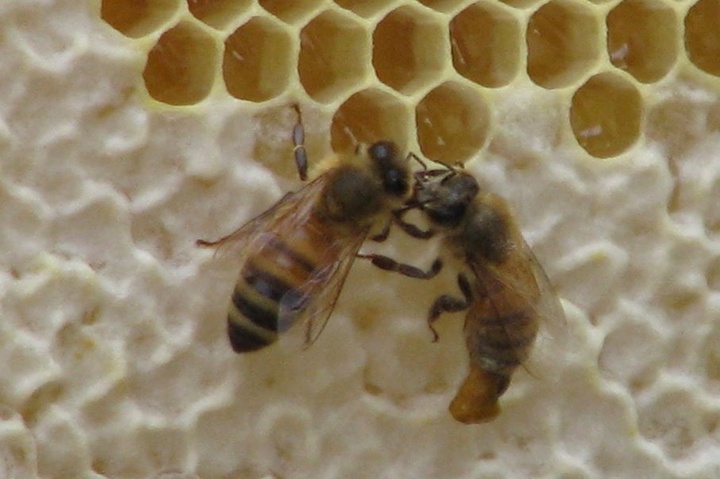
Image(Bees in our first hive passing nectar. The bee on the right has stung and lost her abdomen. Her last act is passing nectar to her sister.)

It was in Portland, one autumn day in 2008, that a bee flew into the apartment that belonged to my new husband and I. We had met at an antiques show the year prior; we had only been married a few months. The bee had flown in through a wonderful old kitchen fan vent and was resting on the counter. My instinct was to find a cup and paper lid to catch and put her outside. But it was a gray and cool day and my husband knew she was exhausted and cold. He had the good mind to heat a plate by running warm tap water on it, drying it off, and dropping a little honey on it. We put the plate near the bee. She quickly smelled the honey and ran over. As she lapped up the drops, she began flexing her wings and abdomen and warming up. We moved her on the plate to the front doorstep and watched her. She ate some more, cleaned herself, and zipped off into the air, but before she left she very clearly hovered and looked around, orienting herself and noting the location.

The next day when I opened the door to leave for work, about a dozen bees were pelting the screen trying to get inside because that’s where they had been told the honey was.

The next week we had our first bee hive.

*

It is said by many beekeepers that the bees choose us, we don’t choose them. People long-fascinated by bees generally have some kind of memorable experience which serves as a final motivation to start keeping bees. Personally, I was rather anti-bug as a child and adult, but then, most of my encounters were with mosquitos, house spiders, or later, gigantic silverfish that continued to crawl even after being smashed in half when living in Chicago. Bees are quite different. Bees have moods and cycles that they will make you aware of. While largely indifferent to their keepers, they will happily inform you when you should leave them be and show clear signs when something is wrong. Bees in no way need us, but we most definitely need them.

The first time that I’m sure I got stung by an actual honeybee, I was on a swarm call a couple of years ago. Swarms are exciting and generally extremely easy to catch. Bees swarm when the population of a hive grows too large for all of the bees to thrive so the mated queen leaves with about half of the colony to establish a new home. The virgin queen remains behind with the rest of the colony, honey stores, and the brood. She is set up to succeed. Swarming is a natural means of reproduction and propagation and because the swarmed bees have no brood or honey to protect, they are generally quite docile.

(A swarm in one of our apiaries.)

For this reason, I tend to get risky with the protective gear. As long as my face is covered, I generally feel like I’m good. At some point during the catch I had taken off my gloves while speaking with the homeowner, and waiting to give the branch the swarm had collected upon another firm shake in order to drop the bees into a box below. But as I walked up to the swarm to monitor their state, one feisty, flying lady landed on my hand with a single mission: she immediately stung me, and died.

Unlike the ensuing meltdown I no doubt had when I was young and had gotten stung, I was so fascinated by watching the bee sting my hand – her rear and abdomen ripping off and the stinger remaining behind – that I forgot about the impending rush of pain that would inevitably occur once her venom pumped in. And that pain did occur, but it wasn’t nearly as bad as the next two days, and the ceaseless itching that occurred.

I often try to think of what small Jill would think of adult Jill. I think in a lot of ways she would think adult Jill is kind of a badass; I think that young Jill is very proud of adult Jill. Young Jill would be wholly impressed that adult Jill is a writer, a teacher, an artist, and gamer (young Jill loved Atari). She would love how much time adult Jill has spent in school. She would probably also think adult Jill was slightly unhinged… what with the lack of food-related limitations and repulsions, and making a life and living out of bees and beekeeping. And she would think it was weird that the homemade bee costume I wore in grade school panned out to mean something – to be a kind of epic foreshadowing, and that despite the somewhat hermetically-sealed suburban and then urban existence I’ve had, the bees chose me.