A Lament and Foreshadow

I want to write about what it has been like to rehab these two little creatures, these dogs, terribly treated prior to our home, and the work to bring them to flourish. Or mostly flourish. As The National sang: Once ruined, baby you stay ruined. While they now thrive, especially Polly, deep parts in both dogs remain vigilant for what their cells remember – muscle memory, conditioned response, PTSD.

These have been the tools used (applicable in most relationships): calm, consistency, patience, schedule, compassion. Some of these might read as synonyms, but are not when employed as verbs.

We are not a yelling people in our house. At worst, we bicker. And we hold no grudges, pull away, ignore. No one goes silent as an attempt to punish or test. It took the dogs very long to realize that no explosive reactions would happen. If a door slams, it is an accident.

If a book slipped or cup broke after she first arrived, Polly would cower in a corner, looking up, bloomed eyes from over a lowered nose, tail tucked and ears slick against her head. She has not done that for years. She would shake and cower if we moved too quickly or, if our voices raised at the TV for sports, she would dash from the room.

Image

Fred is smaller, and came to us far more traumatized than Polly had been. He has seizures, possibly brought about from head trauma, still dislikes his head being touched, and has poor vision. After he eats, he sits and cries. We don’t know why and never will and no amount of consoling him has helped, though the crying no longer lasts for much length of time. He still sometimes rushes away if we move too quickly near him, but not always. More often now, he sits and stares up at us, uncertain at worst. And, observing his worry, we scoop him up in a firm, secure hug.

I know that had we (as stewards of him) been different, more erratic, less patient, we would have driven him over the emotional edge he was occupying when we found him, and he would be a neurotic, chaotic dog in constant misery.

His fright has lessened considerably; he knows we won’t hurt him physically or psychologically. His mistrust of women, and strangers, is extremely lessened. He even becomes curious now and seeks us out, and that is something that levels me to see. While he starts off the night sleeping in a crate, at some point he joins us on the bed, and we often wake up with his head between ours.

Image

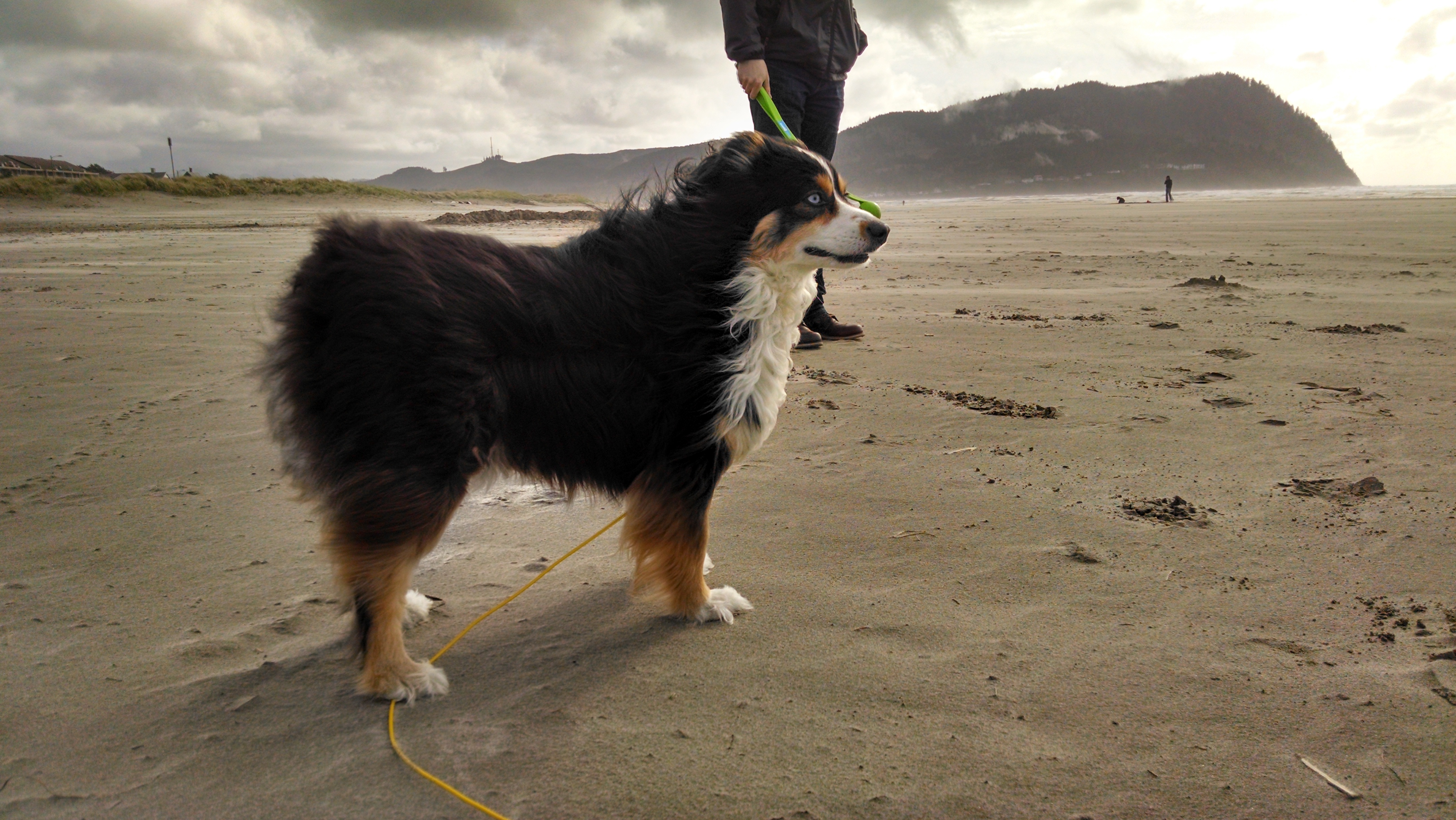
Last week we stayed at the Oregon coast. The Oregon coast is never warm, not truly. It is windy and fairly wild, and often rather stunning. In colder months it is sparsely populated. We took the dogs with, playing each day on the beach. No fences, just expanse, and a ball to chase. They were delighted, and we are delighted to witness their happiness, their trust and thriving. It humbles and levels me to watch.

If this all reads like a lament, in part it is. And I knew it even while we were at the beach. In 5.5 months our first child will arrive. I know from both simple logic and the reminding of others, that soon our dogs will be largely ignored out of necessity and for quite some time. At the beach, I needed to see how happy they can be, their capacity for it, how much they have changed.

I know that what I see in them, the remains of the trauma, is much about me and my own. It’s sort of Lacanian – needing to find a sense of mastery over something I had no ability  to control or effect. The home I needed to actualize for them is the home I have also needed to live in, with patience, calm, certainty, and terminal compassion. For a great portion of my life, I was not so different from these dogs and the state they arrived in, the results of their experience. There is no mystery in that.

Both dogs are alert to change. In the first trimester (of this pregnancy), the dogs took turns resting on my torso (in between my bouts of illness), just protecting me. And, whipping their heads about to watch what was in the air around me – perhaps the mutation of physical and spiritual states, or visitations. They sniff me curiously, lay immediately at my feet, bark at anything they suspect might be nearing our house, be it  leaf or wind or human. Soon they will be weary with me, late at night with a new mewling, wondering why we are up, why the new one is crying, when it will stop. They won’t understand why I don’t have the time for them I used to. But I know they are both healed enough to love the new little one from a place of assurance, and that despite changes, they remain loved, important, and wholly significant.

Image


Weather Report

In a subtle climate, one becomes quick to notice smallest changes; everything we are is about the growing season and how much snow is on the mountain, how high or low the rivers are. Winter has been a worry, on the heels of an odd autumn. Autumn was a prolonged dry spell, with an uncharacteristic metallic sun hanging, and no rain to put the season to bed. The bees were tested with no food left to collect and no signal to huddle inside and wait it all out.

Winter has been sinister-dry with the same sun but a brass color with cheap gold overlay. Except the rain has finally come, not in usual constant drizzle, but in sporadic, protracted, great torrents. Enough to startle us from sleep to check the basement, foundation, outside areas. Today I picked up tree parts in our yard, deposited by trees we don’t even have.

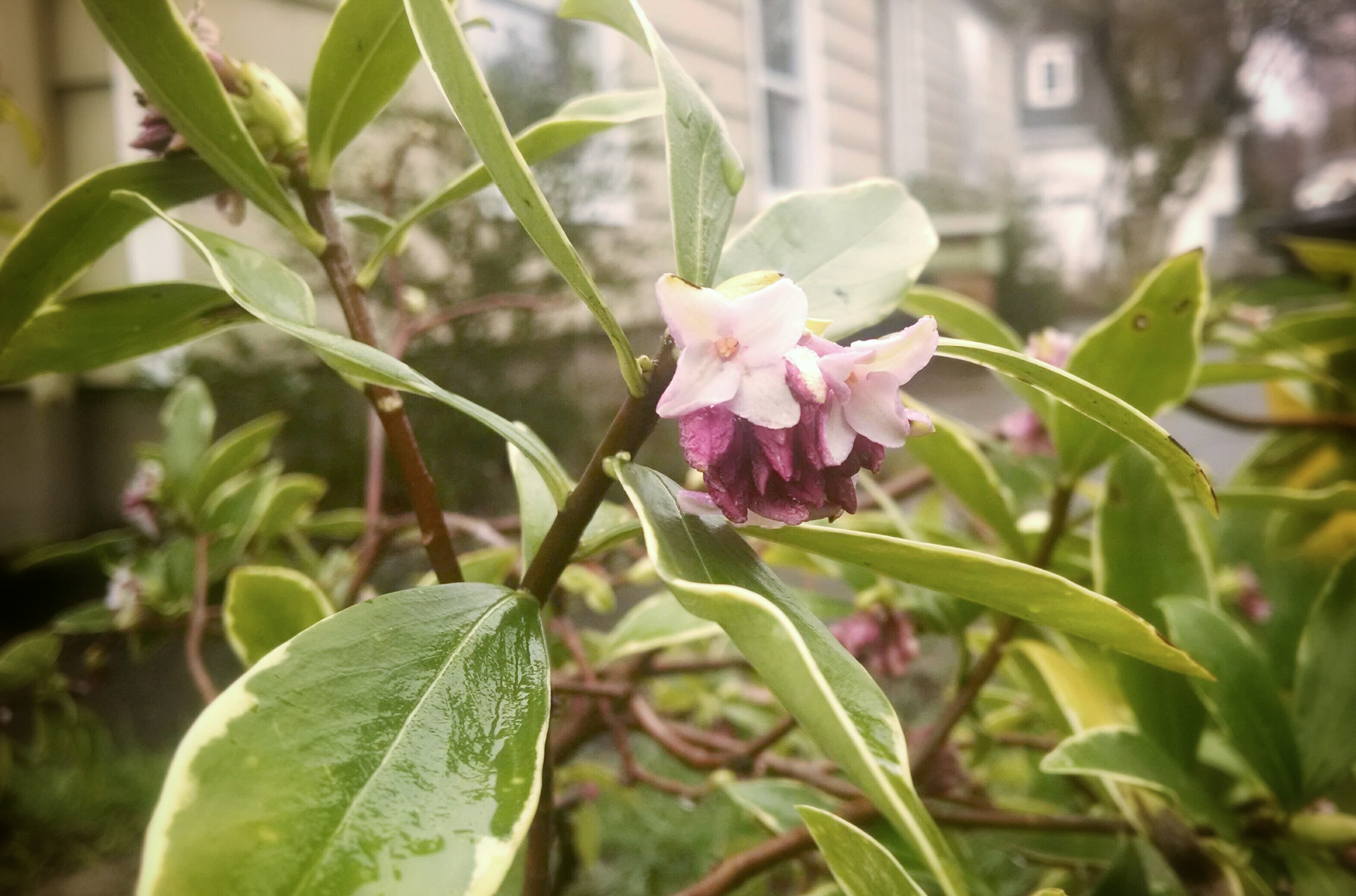
The Daphne is a month late. And now that it has bloomed, those blooms bear brown spots as if it is ready to quit. The usual scent of ambrosia has a sour note like glue; like on its last legs. The ground is past soaked sponges, gone to deep mud for slipping — everywhere is footprints filling in behind.

During a national conference of permaculturists 4 years ago, one told me: Yeah, this will be a rain forest in 50 years. I can see it, and I think about it a lot. Our voices, music, TV have to be turned up over downpours. It’s loud. It sounds like we are living in a washing machine.

I always speak of moving, but where is there to go?

daphne
Some of the more hopeful Daphne.

American Hustle: Review

It took me just over a quarter of David O. Russell’s American Hustle to realize that something else was going on entirely. What I expected was: ‘Oh formula, common-genre, Casino redux with Bale as De Niro.’ And Bale is De Niro, on purpose, but his appearance is 100% Tony Clifton. It would be easy to see the extensive employment of so many hallmarks of American culture as homage, but what’s going on is far more faceted.

It’s soon clear that the title, American Hustle, refers more to the film itself, as well as the film industry and media at large. More than once the characters offer: “People see what they want to see.” While I think the need to underline this fact is heavy-handed and already clear to thinking viewers, it really is the point of the film. Before the film begins, text flashes on the screen claiming: “Some of this actually happened.”
The larger statements of American Hustle wade into theory about art: about sincerity, authenticity, and irony. For anyone that has read it, not recalling Lionel Trilling’s book “Sincerity and Authenticity,” during American Hustle, is nearly impossible, as well as Susan Sontag’s wonderful essay, “Notes on Camp.”  In modern film, where does the sincerity begin and authenticity end? Which is being sacrificed for which, and what is the larger statement? Why do audiences expect entertainment to be hyper-realistic, even when employing genre or fantasy? Where is the artifice and to what end? Why do we ask to get “lost” in film, to perceive it as a reality and suspend disbelief and how far do we really expect that to go? Where do reality and entertainment meet, and why do we need them to meet?

There are stellar of moments of watching Russell exploit artifice to the end of placing all of the above questions squarely in the lap of the audience, whether they know that they are ‘Seeing what they want to see,’ or not. Wonderfully, the heavy stage makeup of Renner and Cooper is regularly visible on their collars. This presents a moment for the audience to make a decision: look past it as a production mistake and stay immersed in the narrative, or observe that Russell is pulling the film down on itself.

There is another absolutely stunning moment between Bale and De Niro. It is framed within the narrative as Bale wondering how much De Niro knows – how much the jig is up, or at least, in jeopardy. But the way Russell crafts Bale’s and De Niro’s characters, what we are watching is Deniro seeing Bale doing his best De Niro in sum totality. It is awkward, and fascinating, and like watching a Father speaking volumes of knowing, frustration, and threat to his son without a single word; without creating a scene. It’s the ultimate: I know what you are doing. You are on thin ice, buddy…

It was said recently by two actresses (Sarah Michelle Gellar and Lizzy Caplan) at a panel on women in TV, that TV allows for 3-dimensional female characters, which is why they prefer the medium. Gellar stated: ‘In movies you can be the wife, the daughter, or the girlfriend, and those roles don’t allow for much development.’ It’s a true statement, which is why Amy Adams and Jennifer Lawrence, (as well as Elizabeth Rohm) are so towering in these roles. They are multi-faceted… finally.

Compared to the men, they are far more realistic – flawed and gifted and charming and terrible at once. By flipping how genders are usually portrayed, Russell allows the women to be the center of the movie, and all gravity generated in the narrative is created by them. The male characters are the one dimensional, doing their best impressions of character actors. It’s perhaps the most important statement about what we expect to see / want to see, and what we are actually seeing. American movie-goers expect women as scenery, providing pure emotion in an inconvenient way for male characters, but what they get in American Hustle is the wonderful, terrible mess of Lawrence, and the gravity, intelligence and perception of Adams. In many ways, this is Adams’ film.

I’m no student of all things Andy Kaufman / Tony Clifton, but with 40 extra pounds on him, Bale (visually) as Clifton doing De Niro is speaking volumes about entertainment, con-art, lying, impression, and authenticity. Throughout the film, women are physically removing his colored glasses, trying to get to the real person, but we can’t know what that means for Russell, or upon first viewing, us.

Russell’s Hustle creates far more questions than it gives answers, but two sorts of audience members will walk out of the film: those that saw what they wanted to see – a fun rehash, and those scratching their heads, with a smile on their faces.

First Sting(s)

Following is a blog post I wrote for Winged’s blog.

The first time I got stung by a bee, I can’t be sure it was a bee. In retrospect it was likely a yellow jacket, but I can’t know. I remember it was a hot, mid-western summer day with insects screaming out their songs: “scKzzzzssT… scKzzzzzssT,” and I was small – probably 6 or so.

I was standing in our narrow garage which was opened to the driveway. Likely I was deciding which vehicle I was going to take out for a spin: the Big Wheel, the pickle car (don’t ask), or the Green Machine. I was not a bike rider. My siblings’ bikes were always too big for me and I was fearful of the heavy frames and the extreme distance to the ground once seated; I wanted to be able to bail out with a soft tumble if need be, not take the hard fall on the concrete, yielding stinging, scraped legs and arms.

Even at that raw age, friends and siblings had long warned me about the possibility of getting stung by a bee, so I wonder if I didn’t just want to get it over with. I had been promised by my friend across the street that the pain would be like death; that I would probably want to die. So that day when a bee flew in the garage and began inspecting me to see if I could possibly yield nectar or pollen, I panicked. I eschewed the instruction that had been drilled into me by my wise, experienced friends and siblings, being: Don’t move, and it will go away.

Naturally, I moved. A lot. In a remarkable, small-child’s dance motivated by fear of an unknown pain. And I began swatting, a lot. From what I can remember, the bee or wasp stung me on the right arm.

(Young me, dressed as something scary for Halloween.)

*

Growing up in suburban Chicagoland, there was almost no authentic relationship with nature; everything was abbreviated. The bug-spray truck drove down our street every summer night and we deeply inhaled that spray while trying to fall off to sleep. Our yard was chemically treated so no dandelions ever appeared. The corn fields at the mouth of our subdivision were sold and built up with houses before I was 10.

Despite that, some of my most vivid and important memories are of the verdurous nature that I could find. I was fascinated when we studied milkweed pods in the first grade – the way they broke and gave up white fuzz.  We had to wear rain boots that day which I didn’t have, so the teacher put garbage bags and rubber bands over my shoes and secured them up my legs.

My best friend had a Macintosh apple tree in her yard. I was charmed. That the tree could swell small green fruits into the ripe red ones I plucked off on warm days and immediately begin gobbling was thrilling. (The humble Macintosh remains one of my favorite snacking apples for this reason.)

The same friend once insisted I borrow her extra pair of ice skates so we could go skating on a pond near our houses. It was the first time I had ice skated and with the snow coming down, it remains a favorite memory. That solid pond, the snow, layers of clothes, no one else around, the gray sky and the pond wrung around with dry straw weeds and tall brown grasses frozen into place.

But by the time I was in highschool, nature had become a foreign locale. As it will, social life had long since taken over as wholly enthralling. At one point my group of friends got really into camping and going away for the weekend. On one trip to Devil’s Lake, everyone decided to go hiking which would involve some basic rock climbing. I eagerly set out with them. My friend Nick, looking down at my shoes, said, “…are you going to wear those?” I shrugged. I had no idea that black and white patent leather wingtips (with leather soles) might not be ideal hiking wear. I somehow managed to hike like a champ with those lovely dress shoes on.

 *

Before I moved to Portland, Oregon, in 2006 the three geographic choices that were before my boyfriend and I were: Portland, New York, and Philadelphia. I advocated for Portland, as I wanted to live somewhere exceptionally beautiful and I was tired of large-metropolitan city life. Chicago had wrung me out. I was depleted, afraid of how hardened I was becoming, and fearful that I couldn’t easily turn off my accent at will.

Upon arriving in Portland, the town was beautiful. I tried to be in love with it or at the very least, meld into it; its newness, fuzzy green firs towering, lush green expanses, welcoming, young population. The relationship I was in quickly fizzled. In one version of the story, the one my friends tell for effect, I dumped him and took his job. The truth is more faceted, but the result was the same.

Spring in Portland is a sublime impossibility, holding the violent bloom of the season against the ache of winter breaking, in one unbelievably sustained note. There are sheer months of walking on beds of petals while the trees billow timid, earnest fragrances. Fall in Portland is equally protracted; months of walking on one long carpet of wadded orange leaves. Residents rake giant mounds into the streets so cars can’t park.

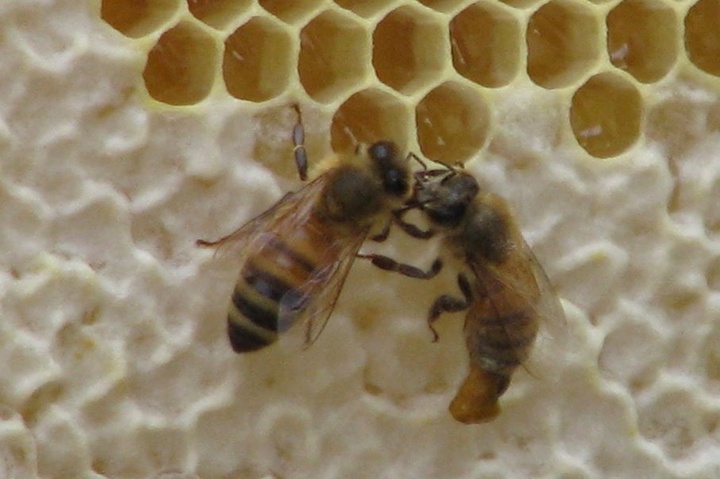
Image(Bees in our first hive passing nectar. The bee on the right has stung and lost her abdomen. Her last act is passing nectar to her sister.)

It was in Portland, one autumn day in 2008, that a bee flew into the apartment that belonged to my new husband and I. We had met at an antiques show the year prior; we had only been married a few months. The bee had flown in through a wonderful old kitchen fan vent and was resting on the counter. My instinct was to find a cup and paper lid to catch and put her outside. But it was a gray and cool day and my husband knew she was exhausted and cold. He had the good mind to heat a plate by running warm tap water on it, drying it off, and dropping a little honey on it. We put the plate near the bee. She quickly smelled the honey and ran over. As she lapped up the drops, she began flexing her wings and abdomen and warming up. We moved her on the plate to the front doorstep and watched her. She ate some more, cleaned herself, and zipped off into the air, but before she left she very clearly hovered and looked around, orienting herself and noting the location.

The next day when I opened the door to leave for work, about a dozen bees were pelting the screen trying to get inside because that’s where they had been told the honey was.

The next week we had our first bee hive.

*

It is said by many beekeepers that the bees choose us, we don’t choose them. People long-fascinated by bees generally have some kind of memorable experience which serves as a final motivation to start keeping bees. Personally, I was rather anti-bug as a child and adult, but then, most of my encounters were with mosquitos, house spiders, or later, gigantic silverfish that continued to crawl even after being smashed in half when living in Chicago. Bees are quite different. Bees have moods and cycles that they will make you aware of. While largely indifferent to their keepers, they will happily inform you when you should leave them be and show clear signs when something is wrong. Bees in no way need us, but we most definitely need them.

The first time that I’m sure I got stung by an actual honeybee, I was on a swarm call a couple of years ago. Swarms are exciting and generally extremely easy to catch. Bees swarm when the population of a hive grows too large for all of the bees to thrive so the mated queen leaves with about half of the colony to establish a new home. The virgin queen remains behind with the rest of the colony, honey stores, and the brood. She is set up to succeed. Swarming is a natural means of reproduction and propagation and because the swarmed bees have no brood or honey to protect, they are generally quite docile.

(A swarm in one of our apiaries.)

For this reason, I tend to get risky with the protective gear. As long as my face is covered, I generally feel like I’m good. At some point during the catch I had taken off my gloves while speaking with the homeowner, and waiting to give the branch the swarm had collected upon another firm shake in order to drop the bees into a box below. But as I walked up to the swarm to monitor their state, one feisty, flying lady landed on my hand with a single mission: she immediately stung me, and died.

Unlike the ensuing meltdown I no doubt had when I was young and had gotten stung, I was so fascinated by watching the bee sting my hand – her rear and abdomen ripping off and the stinger remaining behind – that I forgot about the impending rush of pain that would inevitably occur once her venom pumped in. And that pain did occur, but it wasn’t nearly as bad as the next two days, and the ceaseless itching that occurred.

I often try to think of what small Jill would think of adult Jill. I think in a lot of ways she would think adult Jill is kind of a badass; I think that young Jill is very proud of adult Jill. Young Jill would be wholly impressed that adult Jill is a writer, a teacher, an artist, and gamer (young Jill loved Atari). She would love how much time adult Jill has spent in school. She would probably also think adult Jill was slightly unhinged… what with the lack of food-related limitations and repulsions, and making a life and living out of bees and beekeeping. And she would think it was weird that the homemade bee costume I wore in grade school panned out to mean something – to be a kind of epic foreshadowing, and that despite the somewhat hermetically-sealed suburban and then urban existence I’ve had, the bees chose me.

To read: 75 Years In The Making — Harvard Just Released Its Epic Study On What Men Need To Live A Happy Life

The below linked article, study, findings and subsequent book are fascinating.

http://www.feelguide.com/2013/04/29/75-years-in-th-making-harvard-just-released-its-epic-study-on-what-men-require-to-live-a-happy-life/

A side note that reading this brings to mind: Though I’m not a believer in: “Happiness-is-ALL-and-what-we-should-each-be-striving-for!” person, a baseline of contentment is key (of course) to fostering any fulfilling, mutual relationship and providing a foundation for community and sustained attachment.

I feel the major goal of life should not be the illusion of “happiness at all cost,” but to experience every aspect at its utmost: grief, joy, fault, accountability, elation, humility, self-empowerment, indecision, shame, and so on. Real, personal growth occurs in the most uncomfortable places and when we do not distract ourselves from that experience, but embrace it, sucking the marrow out of every aspect and turn of life. We cannot be versed, multi-faceted individuals if we never remove ourselves from our familiar, worn-grooves of living. That said, this study remains wholly interesting and I need to acquire the book.

(And I’m thrilled that images from “The Tree of Life,” are attached at the bottom. I cannot love that film more than I do.)

Holiday, Chicago, exile

There is an image floating around social networks proclaiming: “Only 10 Saturdays until Christmas!”. It seems odd, and pressing.

Today a friend from back home arrives to stay with us. I realized that he is an old friend, despite having met him when I was 27… I’m old enough to have friends that I met in my late 20s, and have known for a decade.

He and I were roommates in the last apartment that I lived in in Chicago, before I left. That leaving was such a shocking, but natural fissure in my life. As I get older the things that sit on my personal time line, like mines having gone off, retain their potency, but patina in such strange, mutable ways.

When I think of leaving Chicago, I think of breathing after so many years of having prevented any breath. I think of an animal shaking off trauma, just before it darts for the forest line and is gone.

I love Chicago, I miss Chicago, I doubt I will live there again.
In retrospect, and in my writing, what the city is and was for me was an unhealthy relationship of supreme, terminal love — on a cellular level. A meshing and fusion that can’t be undone. A permanent imprinting. And habitual mistreatment. But I think that’s what Chicago is; it’s how it treats its citizens… a punch to the sternum, then it goes in for the cuddle. I was always asking that city for things it wasn’t capable of giving, and it always wanted me to be different than I was.

This was supposed to be a post about time. Maybe it is. Every year, multiple times, I try to figure out how I got here. And how I am still here. Portland is not my place, but Portland wants me. Portland welcomingly spreads out, and gives and gives. But Portland can’t tattoo itself on my vein ways. It’s not my familiar. I’m always a refugee here, or in exile. Equal parts both.

The old friend that is coming to visit understands all of this. We have had long conversations, with Bourbon, about how difficult and compelling Chicago is. He escaped to the west coast not long after I left home, but work took him back after just a few years. Now he is befuddled, asking the same questions that I do: “How did I get here?” and “How am I still here?”

Only 10 Saturdays until Christmas. So, only 9 Saturdays plus a few days until my birthday. Back home, I would often gather some friends and family and head to the Walnut Room for birthday lunch and then The Art Institute after. My family had done that a few times when I was very small. An early memory is of a piece of Buche de Noel set before me in that room, next to the huge Christmas tree. As an adult, it was equally delightful to eat there, surrounded by dressed-up elderly patrons, and moms with kids. There is something strangely nourishing about the loneliness of being next to that huge tree, the ceremony of the season, and the terminal isolation that the city and its architecture provides that I always long for. But then, I was growing so tired of being lonely amongst so much that I loved, living in it, but not being able to get what I needed.
Macys-on-State-Great-Tree
photo: Walnut Room. concieregpreferred.com

It’s come Autumn and Winter that I miss home the most. I love layers and layers of woolens. I  love snow. I love being slapped in the face with cold when the door opens, and the room sighing its warmth back when the door closes. I miss sitting by the lake in Evanston, alone, when the sun is fading white gold and brass colored. I miss my old roommate. I miss the Music Box and the old Fine Arts theater. I miss trains.

But the best Christmas I’ve ever had was two years ago. Having a lot of German blood, from my Mom’s side, while growing up our family opened gifts and did the primary celebrating on Christmas Eve. This puzzles my husband, whose adoptive family is terminally English.

Two years ago I gave up trying to make Christmas Eve *magical.* It’s just the two of us anyway, and the dogs. And Matt barely eats so even if I go all-out on a meal, it’s is pretty lost on him. That year we opened gifts early, had Old Fashioneds per his family’s tradition, and went out to eat at an Indian restaurant. The city was dead but string lights pressed against windows towards quiet, grey streets. We walked around and saw only a few others — people with nowhere to go or avoiding where they were supposed to be going; a few tourists. We walked past windows where people sat at meals chuckling and drinking. I remember how quiet it was, how empty outside on the street.

After dinner we went to a movie in a theater with only a few other hardened holiday soldiers in the seats aside from us. And then we walked to church for midnight service. It was an extremely simple holiday. In retrospect, I think what is most indelible is that by breaking tradition it was acknowledging (personally, internally), that the holiday had become about me waiting for someone(s) that wasn’t/weren’t coming. And who those people are, and what they were to me, or what they could have been, or could be to me.

I remember shockingly early memories of from this life. It has always startled people how early my memory can track back, which later became surprising because of the sheer years in the middle that my brain has wiped out. One very early memory is when a terrible thing happened, and due to it I was in a liminal state, not in this world and not in the other. While in that place, suddenly my Grandfather, who had passed the year before I was born, was standing on my left holding my hand. We were on a cold, dark street at night, under a street lamp glowing cold white light. We were dressed for the chill and looking up at a large white house. Inside, my family was gathered around big table, eating a large meal. Some of them I recognized and some of them I just knew were family. I looked up at my Grandfather and asked him if I could stay with him. He frowned and said no.

I mention this because last week I was driving home at night and puzzling over intimate worries: all of the miscarriages this year, another year without children, losing each of those. The loss of Matt’s dad. Complicated relationships. People I miss. How depleted we are. Raw. And I was panicking about writing and fears of dying without having published or written what I want to. I pulled in the driveway and got out of the car, walking over to the quiet, cold street to get the mail. I was directly under the newly installed street lamp, flipping through envelopes and instantly heard, from a place deeply-seated in me, a male voice say: It’s all going to work out. Just like that.

Here is the point where I would usually take strings from each theme of this piece, relate them in a subtly sentimental way and tie them up to end on a tidy, but potent note, but I’m really disinterested in tidiness. I’m really disinterested in zing-y endings. Interestingly, for someone that spins their brain and mentally chews it into a sad wad of pulp daily, I didn’t think anything immediately after that moment happened, I just stood under the street lamp, looked back at our house, and a split moment of peace and faith that it was true: It’s all going to work out. Of course, that moment passed and I started wondering exactly what that applied to, but try as I might to parse it, I know the statement applies to everything. Knowing that, deeply, on a daily basis is the difficulty. Especially when what I want, what I need, and what I end up with are such different things.

(It should be noted that I I have pneumonia. Again. This is at least my 12th bout of pneumonia in my life. I rank them, from least scary to, ‘holy-wow, I can’t believe I am still alive.’ This one is high up there and is probably partly the cause of homesickness, wandering thought, and fretting about having faith. Pneumonia is an amazing illness. It sits you back, down, hard into yourself, like you are piloting your body from a tiny, tiny room. And everything feels a hundred times more potent than it normally does, yet strangely removed.

Last night I watched the film “Insect Woman,” by Shôhei Imamura, 1963. It was amazing.)

First, position

All that I wanted when I was small (and all I did for a while) was to dance. Through an early and quick series of painful events, dance was nearly ruined for me entirely, but I have never not-known that it was at my core. My fixation on dance and ballet has always remained. I see ballet as a large metaphor for what we ask women (and men, but less so) to do and be in our culture, which is why I find this video fairly thrilling. It’s like The Red Shoes, but taken to the next level.

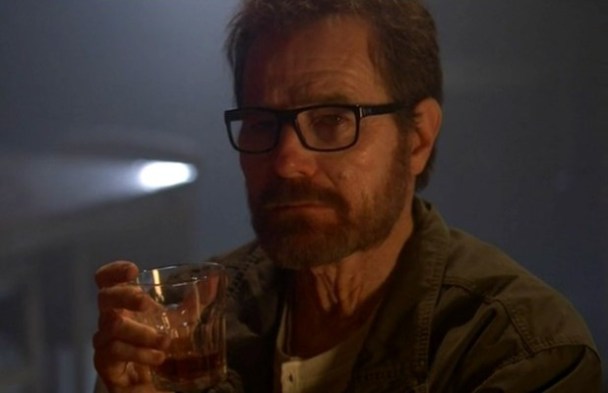
Everything I have written about Breaking Bad in the last 18 hours (SPOILERS)

Image

Dimplepinch, in a pinch. Photo: Breaking Bad, AMC TV.

(I know there are typos here, but I seriously need a break from all things BB and am not combing through it right now… ❤ JM)

“SPOILERS BELOW.

DON’T READ ON.

Tbh, I feel disappointed. I had 3 moments of cheering.

Too. Clean. WHERE IS THE TRAGEDY.

True.

I want Lear. I want the KING of tragedies. I want everything he ever loved to suffer b/c of his choices.

The money??

I wanted him alone, in the desert, to die of a wound or cancer. For a show that is sooo cyclical to not end in the desert, is kinda shameful.

Jesse is broken. Busted. And I’m kinda anti-Jesse these days. I think the homeless person next to his car window when he gives away the money was more foreshadowing than anything. There is no happy ending for Jesse.

No. I want something worthy of Shelley. I want Shakespeare. They held that note for so long… And then pulled back on the throttle.

Oh i know. Reddit is with you. I’m sure the majority of fans are very, very happy. It was nice and tidy.

Reddit is as astounding as it is horrifying. The hive mind is the best of us, and the worst. That many brains going toward anything is pretty stunning. We knew from day 1 that Walt would die and Walt died. To pull back so far from the language that they created for so long was really depressing to me. It’s cool that everyone is pleased. I will take Tony Soprano’s end any day over this. Don’t set up a tragedy or a Western and give me a fairytale. His family is together, they will get the money, the law man got what he knew he signed up for, the conflicted son-figure has served his time physically and is done paying for the Father’s sins… yawn.

Lear is surrounded by the bodies of everyone and everything he loved, knowing it was his own doing and many of them tried to get him to stop and he couldn’t. Not even to say it was all “about him.” In Gilligan’s own words, Walt had his “Gollum/Precious moment” at the end surrounded by the thing he loves most and enveloped in it. Pure ecstasy. Not my bag. Not the show they taught me to read over 5 seasons. Gilligan even hinted at not wanting to leave any loose ends or questions for the viewer. Well, there’s still a lot. And he seemed to be directly hinting at Sopranos when he said it (along with the multiple references to it through the series). I would much rather be left with the emotion that Tony lived in, than WWs pure ecstasy of being surrounded by what he was best at and loved. I’m sure Skyler & Co. can work out their issues when that 10 million gets gifted to them. Too neat. Too tidy.

Also, for a show that would go to the lengths over the years of tying up its loose ends to the Nth, and even told us, seamlessly, in “Granite State” that Badger and Skinny Pete would come back and the body count would be 7, via a 15 years old college hockey game with one of the greatest comebacks in the history of the sport (Wisco. Badgers vs Denver {mascot: Pete}), suddenly we are instructed to not look very closely at things. Walt gets easily into the stolen white Volvo, in an otherwise empty bar parking lot, the cops (despite knowing he was calling from there/is in the area and a *nationwide manhunt for this supposed cop killer*) decide to ignore the car, then never bother looking for where it went or following the tracks in the snow, he is able to drive 8 miles back to his shack to get his money and medicine, and then has no problem at all *driving entirely across country* to New Mexico. In a stolen vehicle. While a nationwide man hunt is going on for him.* And* they know the most likely place he would go is New Mexico. And good thing the Nazi-nest had adobe walls and was on the ground floor and he could totally just pull up to it. And why would pesky Nazis that are casing his car before he enters their compound, bother to check his trunk? I mean, what could Heisenberg, a dying man with *nothing to lose* and the greatest chemist of his time with a thick trail of bodies in his wake possibly do at that point? The only portion of the show I was pleased with was the Gretchen and Elliott part, which e know from reading happened much at the urging of a dying 16 year old boy who asked Vince to show more of their relationship and why it was as it was. I wish the 16 year old had written the whole last episode.

Asking for suspension of disbelief in the *final episode* reads as deperate for me. With blowing up Tuco’s hang out, they said even before it aired, …we know this could never happen and have him live, sorry. Creating an explosion from chemicals and giving the Nazi-nest ground floor adobe walls and Walt a free pass to drive across country are very different things. One of them could actually happen, if you did it correctly and were willing to let your lead take some heavy damage. For such a well-written show to suddenly smear the lens in the last ep. and say, “Don’t look so closely, even though we have taught you that our show is built around you looking closely,” is just bad writing. Yeah the hockey game was an easter egg, like the thousands of easter eggs the show has utilized, teaching viewers to dig deep and turn over every stone… just not in the last episode.

Yeah, as a writer I can’t squint my eyes at it and say: “Yeah. That’s good enough.” They shouldn’t work on the level of constant, thick sub-text and then pull that out suddenly and say, “Okay, turn that off now, stop veiwing along those lines…” They can, but it souldn’t be in the last episode. I would have had Todd go after Skyler and kids, since Lydia told him to finish the job in Granite State. And Skyler would have struggled with him (and died) while Flynn and Holly got away. Thus, Skyler would have sacrificed herself for her kids. Flynn takes Holly and drives madly towards the police presumably, but his bad driving has been talked about for 3 seasons and he would have gotten into a car accident enough to put them both in the hospital. We see Marie visit them and get the idea they will live with her now. This gives Marie something good. I love the Gretchen and Elliott thing. Jesse, after watching his second lover get shot in the head and die and realizing everything has gone too far and he has nothing (and is broken) ties up the loose thread starting in season 1 of “Don’t smoke around the cook site,” and causes anexplosion in the lab when Todd and Uncle jack are there (since Jack has been told repeatedly to not smoke where they cook… Red Phosphorus), knowing it will probably take him out too. Jesse gets harmed but doesn’t die/is dying. Walt shows up and takes out rest of Nazis, has moment of connection with Jesse who dies, and then drives himself out to the desert, returning it to the first scene in the whole show, since up until Felina the show worked cyclically, and plays out the poem Ozymandias by dying of cancer in the desert, alone, with nothing he loves, and having lost it all for his pride and ego’s sake.

Yes, the ending they gave was in service to the viewer, for a show that never was in the first place. Jesse’s life now… and the Hallmark box-making moment. Oh man. Jesse was emotionally done after shooting Gael in the face. I can’t for one second think that after Gael, Jane, Andrea, he is going to have a good life at this point. Why keep him alive and suffering? He has no money, he is wanted in every state, and Badger wants to cook again, per the car scene with WW last night. So why give him/viewers that moment of false hope? He’s a junkie that has made terrible decisions over and over. He’s lovable, but that doesn’t mean he is going to have a good turn out. That was entirely in service to the viewer. And short-sighted.

I thought about the “Need for Speed” too. Ugh.

And the star Trek screenplay stands and played out, which is good because if it hadn’t, they would have wasted 6 minutes at the beginning of this season to it. The “Tolarberry/blueberry pie (meth)” contest first kills Kirk (the captain, Hank, in his Golden colors). It then kills the brainy one — Spock, one often dressed in/represented by blue (Walt), the one in red (Jesse) Chekov (Chekov’s gun) lives because he has help to do so. But, the way the screen play ends also foreshadows a not-happy ending for Jesse, because though well-intended, Scotty (his friend) ends up killing him and we know Badger wants in on the meth action still. And Jesse still needs money.”

Meanwhile, this was going on elsewhere: 

“BB ends for me at Granite State.

In the end, they weren’t true to the writing and the show they had created, they skewed it for the viewer… Heaven forbid they have a Sopranos ending (which is in recent years starting to be cited as a perfect ending and has always delighted me, personally), BB, this show that played elegant-slop for so long and used easter eggs to create multiple sub-texts every episode, suddenly pulled back on the throttle; eschewed all of that good work so VG could give the viewer exactly what he thought they wanted. Wrapped neatly. Tidily. For a show that was never, ever emotionally neat and tidy. Yawn.

It’s one thing for me to have to suspend disbelief to allow the Tuco/office explosion to be cool. Chemicals in the right combination are deadly = true. It’s another thing for in the last episode, WW to drive across country in a known stolen car while a nationwide manhunt is going on for the presumed cop-killer who takes the time to steal the only car in the parking lot (while cops are already there), drive it 8 miles back to his shack (apparently cops have stopped searching surrounding areas), load it up, and then tool along to New Mexico in broad daylight, where authorities know all of his ties are and is where he will likely head. And then, conveniently the Nazi “club house” has adobe walls and is on the ground floor and he can pull up directly next to it. And Nazis, when inspecting cars, never inspect the trunk, even though Heisenberg has nothing to live for and nothing to lose. And that doesn’t even get into the actual plot writing and mechanics. I’m glad so many are happy. That’s honestly really cool and what VG wanted. It ends for me at Granite State, with the phone dangling and him walking back to his seat.

I don’t know what that means… for me? Regarding the magnet, I liked that Vince and co. went to the trouble of saying right away, “Yeah, we know this magnet thing would never work at all, it was just cool.” It’s an incident that develops Jesse’s character and shows how far gone Walt is (sticking the truck to the building and then abandoning it). Very different than, “this is the last episode and we just have to get him to NM, so don’t think about the authorities that have been hunting him for close to a year and the fact that they think he killed two cops, …we just wanna give you guys he ending you want!” That’s not the show that was written up to that point. I wanted them to be true to the writing and show, not the viewer, but I understand why VG wanted everyone to be happy.

I didn’t feel due a different outcome. I hoped for more from writers that have always shown they were capable of more. That’s all. Felina, for me, was BB shitting the bed.

 I don’t understand why it would, it’s just my experience. They taught me to read that show so closely and in very specific ways. Using those exact tools they gave me, Felina fell apart. For me.

I am!! It’s a great show!! Through Granite State!

I didn’t think you were, I just wanted to be clear on that point myself. I don’t want to sound like I’m griping to gripe so I hope it doesn’t come off that way.

It’s too bad we didn’t end up watching all together; we had a serious breakdown session with our BB View Crew after the ep. and it would have been fantastic to have your views included. Also, we had hot spiced vanilla cider and local rum to fuel the fires of discussion.”

And then finally,

“The weirdest thing I have ever seen, of any show ending, is the need for those that are pleased with the ending to over-explain why, to those that didn’t share their positive experience. And then, try to prove why they are right for thinking it’s fantastic. I’ve never seen anything like it. It’s been very, very odd to me that anyone cares that I didn’t like it past, “Ah, I can see how you might see it that way, here’s what I saw…” Not since The Sopranos, has an ending been so controversial, and the interwebs were still too wobbly-legged then to see this kind of result occur. It’s somewhat fascinating” …and it’s depressing.

Letter grade: Meh.

Winged: New Writing on Bees

I’m co-editing a literary anthology: Winged: New Writing on Bees. The submission window is open. We are calling for essays, fiction, poetry, and cross-genre work speaking to bees, pollinators, the relationship between artists and bees, the human/pollinator relationship… Please follow the link to learn more, and share with your friends and fellow writers. A portion of proceeds from sale will be donated to pollinator conservation non-profits.

winged-button25

Aside from that, Autumn-busy-time. Just returned from Pennsylvania and the Mother Earth News Fair for the business, Bee Thinking. It was a huge event. Matt spoke to a very large audience on Saturday about beginning beekeeping & top bar hives.

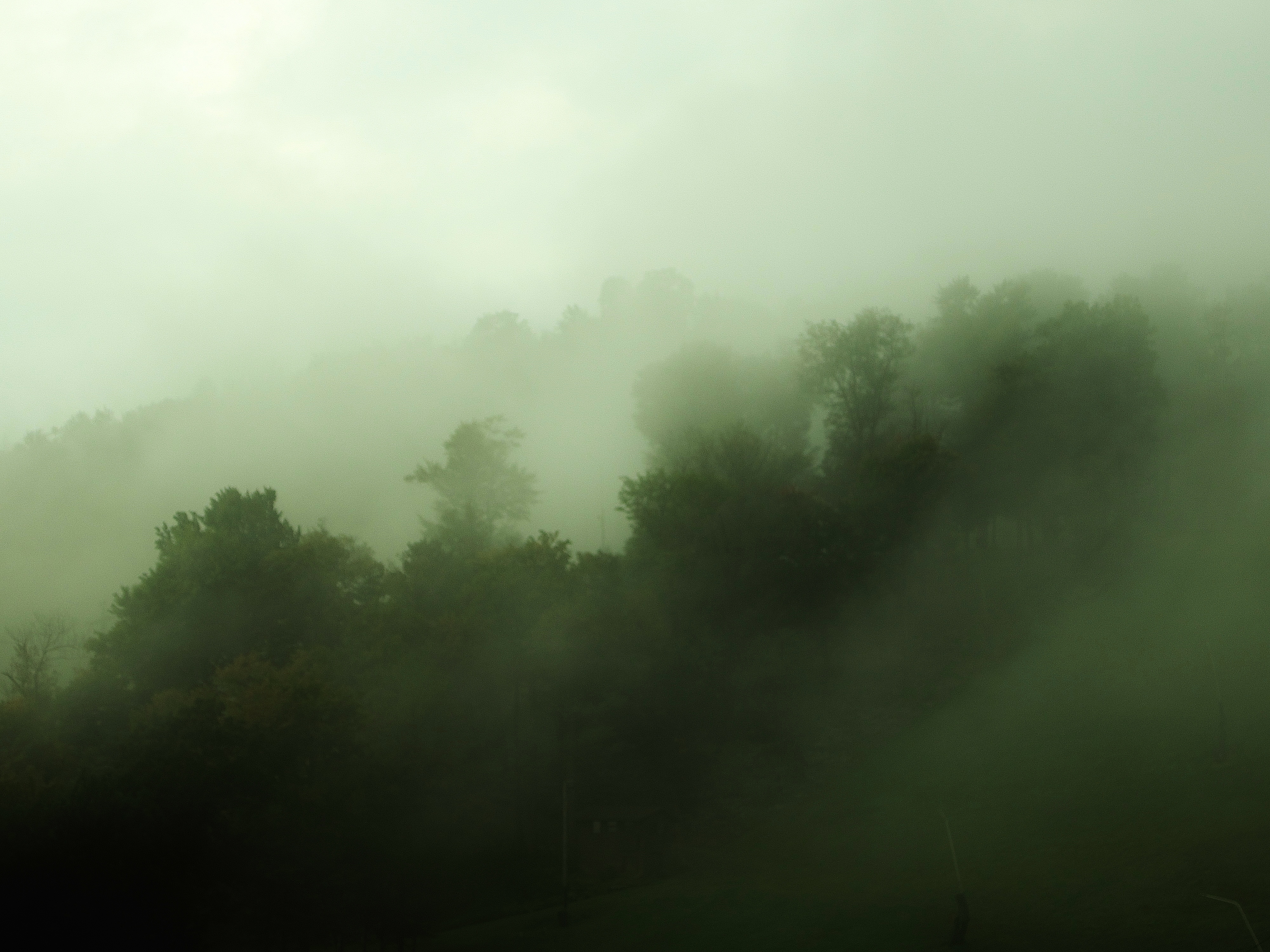
misty

Pennsylvania.

A torrential downpour wiped us out for a few hours. All of us were wet for the whole day, and a small river spawned and flowed through our booth. Standing in small ponds and trying to save everything from being ruined was exciting. My phone was one casualty. The  most vivid memory was of trying to get our tent walls put up, and the water from the roof running up my sleeves and all the way down my body inside my clothes, into my boots and puddling.

This was my second visit to Pittsburgh and I must say, I find it altogether fantastic. It’s lovely and livable and the right mix of East Coast zero-tolerance for BS, and Midwest down-to-earth folks. Plus, gorgeous architecture, history, and the Penguins.

In October we go to Lawrence, KS. Same event, different town. Hopefully with less rain and better food.

I keep trying to edit and post a long entry I have about miscarriage to share here, but it just sits there, driving home part of the point of the whole thing: that no one talks about miscarriage.

Regarding Breaking Bad, which consumes a great deal of my thoughts these days, I am constantly picking at threads regarding King Lear (as its themes and plot corresponds to BB), Hamlet (with regard to Jesse), the idea of Shakespearean tragedy and / vs. Greek tragedy, what each of Walt’s “sons / creations” say about his devolution (Walt Jr./Flynn, Jesse, Todd), and of course obsessing about color theory and symbolism (Holly in a yellow hat!!). In one way, I can’t wait until the whole thing is over so that I can look at the entire thing and analyze it as a whole, versus picking the bones of each episode, weekly.

the tarnished end of the summer

It’s the tarnished stretch of late summer when everything is angry. The light is metallic. In the garden, the crows are too close and screaming, yellow jackets war with bees at hive entrances; everything moaning late attempts for food & screeching on about their efforts for the season change. Outside, everything stings, or scrapes. For their earnestness, I love the crows most.

Yesterday was last day of summer term. I made my poetry students read a few pieces from their final portfolios. I began the reading with a delivery of much of the first section of CA Conrad’s, “The Book of Frank,” forgetting that the first page drops the word cunt at least five times, and the whole first section is pretty much about how one learns about sexuality inside of a family. All I remembered were the images, like: mysterious violets left on the laps of dinner party guests. Some of my poor students were probably scandalized. That said, they all kind of flocked around me at the end of class. There were many adieus and thanks exchanged.

I had a dream David Bowie came over for Pimm’s Cups but couldn’t stay, then Nick Cave came over for dinner. He helped me in the kitchen, making a salad, and listened to my creative worries and ‘what’s the use(s)?’. He gave me a magic hat with a tiny universe inside of it and told me I could come stay at his house in Sussex and use his jeweler’s bench.

I was trying to take a photo a day in August, but they all ended up being the dogs, or things I’m cooking. Although, a praying mantis appeared outside our door and stayed long enough for me to stare, though she was clearly irritated.

In the yard, the grass is beige straw, and the vining morning glorys are strangling the Ceanothus. Every seed that hit the ground, died. One of the cherries withered and was pulled out. The Linden can’t get enough water, the Hawthornes need to be cut away from everything, & the hornets have found a way in our house. The humidity is holding: 90%. As usual, I’m waiting for summer to pass and for it to be cool, a soft compress when I open the door and go out.

Reading:

Scores of film journals now available online… all of my time is now spoken for.: http://lantern.mediahist.org/